
Spain's Liux Big Microcar Bets on Sustainability to Challenge Chinese EV Dominance
TL;DR
- Spanish startup Liux is launching the Liux Big, a Spain-built L7e electric microcar focused on ultra-sustainable materials including flax fiber, recycled polymers, and bio-composites to differentiate from low-cost competitors.
- With a targeted price under €10,000, a range of around 200 km, and a simplified, modular design built for local manufacturing, Liux aims to avoid direct price wars with dominant Chinese micro-EVs.
- The company's bet is that European consumers will pay a small premium for a locally-made, circular-economy EV with a lower carbon footprint, though analysts warn sustainability alone may not overcome China's scale and pricing power.
More Than Just Another Microcar
The European electric microcar segment is booming, but it's also getting crowded. From the Citroën Ami to a wave of affordable imports from China like the ARI Soleno and Wuling's expanding lineup, the streets of Paris, Madrid, and Berlin are filling with tiny, low-cost EVs. Now, a Spanish startup wants to carve out its own lane — not by being the cheapest, but by being the greenest.
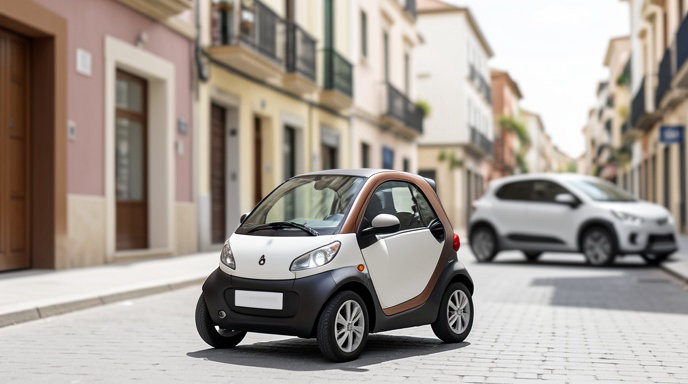
Liux, the Santa Pola-based company previously known for its ambitious Liux Animal crossover concept, is shifting gears with the Liux Big. It's a compact, all-electric quadricycle designed specifically for the European L7e category, and its entire pitch rests on one idea: true sustainability from factory to road.
Built in Spain, Built to Last — and to Be Recycled
Unlike most microcars that rely on conventional steel and plastic bodies shipped from overseas, the Liux Big is designed around a radically different material palette. The startup says up to 80% of its body panels are made from natural and recycled materials.
The chassis and exterior panels use a flax fiber and bio-resin composite, similar to the technology Liux developed for the Animal, combined with recycled PET and polypropylene. Inside, the company is replacing traditional plastics with cork, reclaimed wood fibers, and recycled textiles. Even the manufacturing process is part of the story. Liux plans to produce the Big at a small-scale, low-impact facility in Spain using 3D printing and resin infusion techniques that it claims cut energy use and CO2 emissions by up to 70% compared to a conventional small car factory.
The goal is not just a low-emission car in operation, but a low-emission car in creation and disposal. The body is designed to be modular and easily separable at end-of-life, making recycling and repair far simpler than with a welded metal body.
Simple Specs, Smart Strategy
The Liux Big is not trying to win on performance. As an L7e heavy quadricycle, it is limited to 90 km/h, making it ideal for city and suburban use rather than highway driving. Liux is targeting a real-world range of approximately 180 to 200 km from a compact 14-15 kWh battery pack, which is swappable and designed for second-life energy storage.
Weight is kept under 550 kg without the battery, which helps maximize efficiency. The interior is minimalist by design — a single central screen, two seats, and surprisingly generous cargo space for its footprint — keeping both cost and complexity down.
Pricing is expected to start between €9,500 and €9,900 after incentives, positioning it slightly above the cheapest Chinese imports but well below the Renault Mobilize Duo or Microlino. Pre-orders have reportedly opened in Spain with a refundable deposit, with first deliveries targeted for late 2026 to early 2027.
David vs. Goliath: Taking on China
Liux's biggest challenge is not engineering, but economics. Chinese manufacturers dominate the micro-EV space thanks to massive scale, vertically integrated battery supply chains, and aggressive pricing that European startups simply cannot match on cost alone.
Liux's counter-strategy is to refuse to play that game. Instead of competing on price-per-kilometer, it is competing on values and proximity. By building locally in Spain, the company avoids import tariffs, long shipping logistics, and the carbon footprint associated with them — a growing concern for environmentally conscious European buyers and regulators. Its simplified, 3D-printed production model also requires far less capital expenditure than a traditional gigafactory, allowing for profitable small-volume production of a few thousand units per year.
The company is also leaning into the circular economy as a selling point for fleets and car-sharing services, offering a take-back and refurbishment program for batteries and body panels that could lower total cost of ownership for corporate clients.
Can Sustainability Be a Superpower?
The question remains whether enough buyers will choose green credentials over the lowest sticker price. Market analysts note that while European consumers increasingly say they value sustainability, price remains the number one driver in the microcar segment, which is often purchased as a second car or by young drivers.
However, Liux may be timing its bet perfectly. The EU is tightening rules on battery passports, carbon border adjustments, and lifecycle emissions reporting, which could erode the price advantage of imported EVs with less transparent supply chains. A "Made in Spain" microcar with a documented low-carbon footprint could benefit from future subsidies and appeal strongly to cities looking to green their municipal and sharing fleets.
Liux is not promising to outsell the Chinese giants. It is promising an alternative: a slower, smaller, and far more thoughtful kind of electric car. If it can deliver on its production promises where many other EV startups have stumbled, sustainability might just be enough to make the Liux Big more than a niche curiosity.

Get All The Latest Updates Delivered Straight To Your Inbox For Free!