
From Mines to Models: How Caterpillar Is Turning Decades of Autonomous Mining Into Scalable AI Deployment
TL;DR
- Caterpillar has quietly become one of the world's most experienced AI operators, with over 1,000 autonomous haul trucks moving more than 5 billion tonnes of material with zero autonomous-related injuries.
- Lessons from automating remote, high-stakes mining environments — including fail-safe design, edge computing, and human-centered autonomy — are now the blueprint for Caterpillar's broader industrial AI strategy.
- The company is scaling that proven model beyond mining into construction, energy, and quarry operations through its Cat® MineStar™ and Cat AI platform, focusing on reliability and ROI over hype.
Decades Before Chatbots, There Were Autonomous Haul Trucks
While Silicon Valley was still debating the future of self-driving cars, Caterpillar was already letting 400-ton trucks drive themselves. The company began experimenting with autonomous mining in the 1990s, and by 2013 had deployed its first commercial autonomous fleet. Today, that early bet has made Caterpillar an unlikely leader in real-world AI deployment.
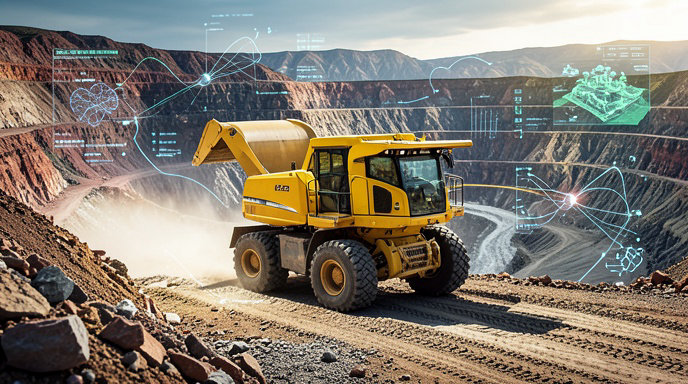
As of mid-2026, Caterpillar reports more than 1,000 Cat® Command for hauling autonomous trucks operating across 23 mine sites on three continents — from the iron ore pits of Western Australia to oil sands in Canada. The fleet has autonomously hauled over 5 billion tonnes of material and traveled more than 300 million kilometers, all without a single lost-time injury attributed to autonomous operation. In an industry where downtime costs tens of thousands of dollars per hour, that track record is the ultimate proof point.
For Caterpillar, autonomy was never a science project. It was a survival requirement.
Why the World's Harshest Workplace Became the Best AI Lab
A remote open-pit mine is the antithesis of a controlled lab environment. There is no high-speed fiber, no clean data, and no room for error. Temperatures swing from -50°C to 50°C, dust blinds sensors, GPS can be patchy, and a single mistake can endanger lives and halt production.
That harsh reality forced Caterpillar to solve the problems that are now stalling enterprise AI adoption everywhere else. Three principles emerged that now define its approach to scalable AI:
1. Reliability Over Novelty. In mining, an AI model that is 99% accurate is still dangerous. Caterpillar engineered its autonomy stack for deterministic, predictable behavior first — prioritizing safety and uptime over cutting-edge complexity. Every autonomous decision has a verifiable fallback and a human in the loop at the remote operations center.
2. AI at the Edge, Not Just the Cloud. With limited connectivity thousands of miles from the nearest city, Caterpillar couldn't rely on the cloud. Its autonomous system runs on ruggedized edge computing onboard each machine, processing lidar, radar, and camera data in real time. That edge-first architecture is now central to its industrial AI platform, allowing real-time inference even when disconnected.
3. Automate the System, Not Just the Machine. Caterpillar quickly learned that an autonomous truck is useless without an autonomous mine. Its MineStar™ ecosystem orchestrates the entire operation — dispatching, traffic management, fueling, and maintenance — so humans and robots can work together safely. The AI doesn't just drive; it manages the workflow.
This systems-level thinking is what separates industrial AI from a demo, according to Caterpillar executives. The goal was never to remove people, but to move them out of harm's way and into higher-value roles supervising fleets from remote command centers.
From MineStar to Everywhere: Scaling the Blueprint
Caterpillar is now explicitly productizing those decades of lessons. The company is expanding its autonomy and AI offerings under a unified Cat AI and autonomy portfolio that extends far beyond mining.
In late 2025 and early 2026, the company announced major expansions of its autonomy strategy. This includes bringing Command for hauling to smaller quarry and aggregates operations, launching autonomous solutions for large dozers and drills, and rolling out Cat VisionLink™ and predictive health AI that turns sensor data from millions of connected machines into actionable maintenance and productivity insights.
The key is transferability. The same stack that allows a haul truck to navigate a dusty mine without human intervention is being adapted for autonomous water trucks, drills that can precisely place explosives, and construction machines that can grade a site to within centimeters. For customers in construction and energy, the pitch is simple: this isn't experimental AI. It's the same proven technology that has already moved billions of tonnes of rock.
The company has also leaned into an open ecosystem approach, partnering with mining giants like Rio Tinto, BHP, and Newmont, as well as technology providers including NVIDIA for edge AI computing, to accelerate development without sacrificing its core focus on safety and interoperability.
The Industrial AI Playbook Silicon Valley Is Now Studying
Caterpillar's journey offers a counter-narrative to the generative AI boom. While much of the tech industry is focused on models that create content, Caterpillar is focused on models that create outcomes — measured in tonnes moved, fuel saved, and injuries prevented.
The results are tangible. Customers report up to 30% improvements in productivity, 15-20% reductions in fuel consumption, and significantly extended machine life thanks to AI-driven predictive maintenance and more consistent autonomous operation. More importantly, autonomy has allowed mines to keep operating through labor shortages and to dramatically improve safety by removing operators from the most dangerous environments.
The lesson for other industries is clear: successful AI deployment isn't about the most powerful model, but the most reliable system. It requires deep domain expertise, obsessive data validation, and a willingness to build for the edge case — literally.
What Comes Next
Caterpillar's next frontier is full-site autonomy and greater human-AI collaboration. The company is investing heavily in generative AI for maintenance troubleshooting, digital twins that simulate entire mine operations before a single truck moves, and more advanced perception systems that can handle increasingly complex, mixed fleets of autonomous and manned equipment.
The vision is not a fully lights-out mine, but a smarter, safer, and more efficient one where AI handles the repetitive and hazardous tasks, and people handle the strategic decisions.
After 30 years of proving autonomy where failure is not an option, Caterpillar is no longer just an equipment manufacturer. It is an industrial AI company — and its proving ground was never a test track in California, but a mine in the middle of nowhere.

Get All The Latest Updates Delivered Straight To Your Inbox For Free!