
Crusoe Scraps $1.25B Boom Turbine Plan for AI Data Centers
TL;DR
- Crusoe has walked away from its $1.25B plan to use Boom Supersonic-derived gas turbines to power its AI data centers, ending one of the most unusual bets on solving AI's energy crunch.
- Boom CEO Blake Scholl confirmed the turbines are no longer in the company's near-term plans as Boom refocuses entirely on its Overture supersonic airliner and Symphony engine certification.
- The breakup underscores how hard it is to bring new, non-traditional power to AI data centers fast enough, pushing Crusoe back toward conventional gas, grid power, and established turbine suppliers.
A High-Flying Power Plan Comes Down to Earth
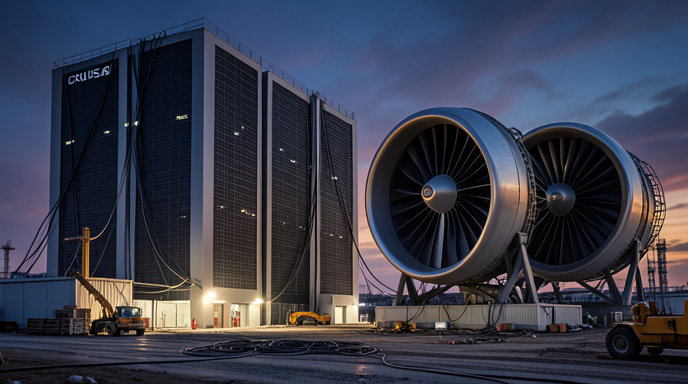
When it was first floated, it sounded like pure Silicon Valley-meets-aerospace ambition: take jet-engine technology from Boom Supersonic and repurpose it into power plants for Crusoe's AI data centers. The $1.25 billion arrangement was supposed to deliver fast, off-grid electricity at a time when AI labs can't get enough megawatts.
That vision is now officially grounded. Crusoe has confirmed it will not move forward with the Boom turbine deployment, scrapping a plan that had become a symbol of how desperate — and creative — AI infrastructure companies have become to secure power.
In an industry where data center deals are usually about transformers, substations, and utility interconnections, the Crusoe-Boom tie-up stood out. It promised to bypass the clogged grid entirely with mobile, gas-fired turbine systems derived from aerospace designs.
Why The Deal Fell Apart
According to people familiar with the matter, the split came down to timing, scale, and focus — not technology failure.
First, speed was a problem. Crusoe is racing to bring gigawatts of AI capacity online for clients like OpenAI and others building out Stargate-linked infrastructure. Its data centers in Texas and elsewhere need firm power in months, not years. The Boom-based turbine system, while promising on paper, would have required additional engineering, packaging for stationary power use, testing, and manufacturing scale-up before it could deliver at data-center scale.
Second, economics shifted. Building a brand-new turbine supply chain from an aerospace program is expensive and risky compared to buying proven aeroderivative turbines from GE Vernova, Siemens Energy, or Solar Turbines. With natural gas prices volatile and investors pushing Crusoe toward bankable, de-risked power strategies ahead of its massive buildout, a first-of-a-kind solution became harder to justify for the $1.25B price tag.
Third, priorities diverged. Boom is under intense pressure to deliver its Overture supersonic jet and get its Symphony propulsion system through development and certification. Spinning off a parallel energy business, even a lucrative one, would have stretched engineering talent and capital at a critical moment.
In short: Crusoe needed electrons now, Boom needed to build airplanes first.
What Blake Scholl Said About The Shift
Boom CEO Blake Scholl addressed the change directly, framing it as a strategic narrowing rather than a falling-out.
Scholl said power turbines are no longer in Boom's near-term plans, and that the company has decided to concentrate all of its engineering and manufacturing bandwidth on Overture and Symphony. While he has previously talked up the potential for Boom's turbine technology to have stationary power applications, he acknowledged that commercializing a data center power product would be a major undertaking of its own — essentially a second company.
Scholl emphasized that Boom remains bullish on the need for new power for AI, but said Boom's contribution will have to wait until after its core aviation program is further along. He left the door open to revisiting energy applications long-term, but made clear there is no active development timeline.
Crusoe, for its part, characterized the decision as mutual and pragmatic, noting it continues to explore a wide range of power solutions but will prioritize options that can be deployed at scale on its current construction schedule.
What It Means For AI Energy Infrastructure
The collapse of the Crusoe-Boom plan is more than one dead deal — it's a reality check for AI's power gold rush.
Over the past 18 months, AI builders have chased everything from behind-the-meter gas plants to nuclear SMRs, geothermal, fuel cells, and now jet-derived turbines to escape years-long grid interconnection queues. The Crusoe-Boom breakup shows the limits of exotic solutions: utilities, regulators, and hyperscale customers still favor proven, financeable power.
For Crusoe, the pivot likely means doubling down on what works. The company has been aggressively locking up natural gas supply, grid-connected sites, and traditional turbine orders, while also pursuing solar-plus-storage and other firming strategies. Expect it to replace the Boom capacity with orders from established manufacturers who can guarantee delivery dates, warranties, and maintenance networks — critical for data centers that can't afford downtime.
For the broader market, analysts say the lesson is clear: AI data centers will need 50+ gigawatts of new power in the U.S. alone in the coming years, and that scale favors incumbents. Novel ideas aren't dead — SMRs and advanced geothermal are still attracting billions — but they will need to prove they can meet AI timelines, not just AI headlines.
Boom's exit also refocuses attention on its aviation milestones. With Overture development entering a make-or-break phase, investors largely welcomed the move to cut distractions, even if it means walking away from a $1.25B energy opportunity.
The Bottom Line For Crusoe's Next Gigawatts
Crusoe scrapping the Boom deal doesn't slow AI demand — it just sends Crusoe back to a more conventional playbook to meet it. In the race to power AI, boring and on-time is beating bold and late.
Crusoe still aims to be one of the largest builders of AI data centers in the world, but its future electrons will likely come from familiar sources: large-frame gas turbines, utility partnerships, and grid upgrades, not supersonic spin-offs.
The $1.25B turbine dream made for great headlines about the future of AI energy. Its quiet end is a reminder that in infrastructure, execution beats imagination.

Get All The Latest Updates Delivered Straight To Your Inbox For Free!