
AI Agents vs Websites: The Battle for Access and the New Standard to Fix It
TL;DR
- Personal AI agents that can shop, book travel, and make reservations are being routinely blocked by anti-bot systems like Cloudflare, DataDome, and PerimeterX, causing up to half of agentic tasks to fail.
- Websites are resisting to protect ad revenue, prevent server overload and fraud, stop unauthorized scraping for AI training, and preserve direct customer relationships.
- A new stack of open standards — including MCP, Google's A2A and AP2 payment protocol, Visa and Mastercard's agentic commerce programs, and Cloudflare's pay-per-crawl model — aims to replace blocking with verified, permissioned agent access.
The Promise: Your AI Does The Clicking
Imagine telling your phone: find me the cheapest nonstop to Chicago next Friday, book an aisle seat, reserve parking, and grab dinner for two at 7:30 near the hotel. No tabs, no forms, no CAPTCHAs.
That is the vision Silicon Valley sold for 2025 and 2026. OpenAI's Operator, Anthropic's Claude with computer use, Amazon's Buy for Me and Rufus, Google's Project Mariner and Gemini agents, Perplexity's shopping assistant, and a wave of startups like Rabbit, Adept and MultiOn all promised the same thing: personal AI agents that browse the real web for you.
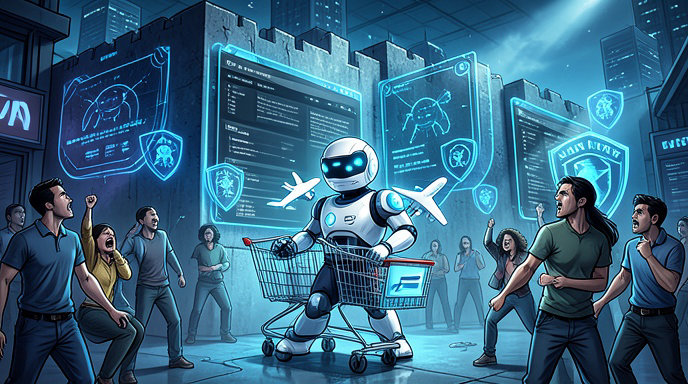
In demos, it looks magical. In practice, it often breaks on step one. The agent opens the airline site, spins, and gets hit with "Verify you are human," "Access Denied," or an endless Cloudflare challenge. It can't add to cart, can't check out, can't log in.
We built agents to use the web like humans. The web thinks they are bots — and it is fighting back.
Locked Out: How Big Is The Block?
This is not anecdotal anymore. Throughout late 2025 and 2026, testing by agent developers, retailers, and bot-mitigation firms has found staggering failure rates for unauthenticated web agents.
Anti-bot vendors built to stop sneaker scalpers, credential stuffers, and scrapers now treat AI agents exactly the same: datacenter IP addresses, headless browsers, superhuman speed, unusual mouse movements. Cloudflare, which protects around 20% of the web, made the shift explicit in July 2025 when it began blocking AI crawlers by default and requiring site owners to opt in to AI access.
The result is a silent war. Ticket sellers, airlines, sneaker retailers, restaurant reservation platforms, and publishers are among the most aggressive blockers. Some return hard 403 errors to known agent frameworks. Others serve fake pricing, trap pages, or infinite puzzles. Even when agents use consumer tools like OpenAI's Operator with real user logins, many sites still flag the session as automation and kill it mid-checkout.
For agent labs, it is an existential problem. An assistant that can only complete 4 out of 10 bookings is not a personal concierge. It is a demo.
Why Websites Are Saying No
From a site owner's perspective, blocking is rational. There are five core reasons:
First is money. The modern web runs on eyeballs. If your agent reads 10 hotel listings, summarizes them in chat, and books via an API, the site loses page views, ad impressions, affiliate clicks, and upsell opportunities. Publishers in particular fear a future where AI answers replace visits entirely.
Second is cost and performance. Agentic browsing is incredibly inefficient. A human loads three pages to book a flight. An agent might load 30, retry forms, re-render JavaScript, and hammer search endpoints. Multiply that by millions of agents and you get what Cloudflare CEO Matthew Prince has called a DDoS-scale burden — massive bandwidth bills with zero human customer attached.
Third is trust and fraud. How does United Airlines know that the bot trying to use your frequent flyer miles is actually authorized by you? Stolen cookies, prompt injection, and delegated credentials make agents a perfect cover for fraud, account takeover, and scalping. Without strong identity, allowing agents in is a security nightmare.
Fourth is data control. After two years of having content scraped for model training without permission or payment, publishers and marketplaces do not want to give AI companies free automated access to real-time pricing, inventory, and reviews.
Fifth is experience and liability. If an agent books the wrong $2,400 refundable fare, orders the wrong size, or violates a restaurant's no-show policy, who is responsible? The customer blames the business, not OpenAI. Many brands would rather block than clean up agent mistakes.
Caught In The Middle: What It Means For You
For consumers, the battle creates a confusing, half-working future.
On one day, your AI books a DoorDash order flawlessly. The next, it fails at checkout on Best Buy, cannot get past Ticketmaster's queue, or gets logged out of Delta for suspicious activity. Tasks stall, you have to take over manually, and you may not even know why it failed.
There are also hidden risks. To get around blocks, some agents ask you to hand over passwords, install invasive browser extensions, or store credit cards in unregulated wallets. That increases phishing and fraud risk. And when agents do succeed by evading bot detection — essentially pretending to be human — they violate sites' terms of service, which could get your account flagged or banned.
In short: you were promised autonomy, but you got the CAPTCHA wars all over again.
The Fix: From Sneaking In To Checking In
The industry consensus emerging in 2026 is that screen-scraping humans was always a hack. Agents should not sneak in through the front door. They need their own side door — with ID, permissions, and payment.
That side door is now being built as a stack of open standards:
Model Context Protocol, or MCP, launched by Anthropic in late 2024 and now widely adopted, including by OpenAI and Microsoft, gives agents a structured way to call tools and retrieve data instead of clicking buttons. Instead of parsing HTML, an agent asks a store's MCP server: what is in stock, what does it cost, can you hold this reservation?
Agent-to-Agent protocols like Google's Agent2Agent (A2A), donated to the Linux Foundation in 2025, let a personal assistant agent negotiate directly with a merchant's sales agent.
For identity and payments, the biggest breakthrough is Google's Agent Payments Protocol, or AP2, announced with 60+ partners including American Express, PayPal, Shopify, and Coinbase, alongside Visa's Intelligent Commerce and Mastercard's Agent Pay. Combined with the revival of HTTP 402 Payment Required, these let you cryptographically delegate a spending limit — say, up to $350 for flights — so the merchant knows the agent is acting for you and can charge you securely without seeing your full card number.
And for access control, Cloudflare, Automattic, and publishers are pushing NLWeb from Microsoft, pay-per-crawl marketplaces, and updated robots.txt-style manifests where sites can declare: agents welcome here, at this price, for these tasks, with this credential.
Think of it like the shift from wild scraping to the App Store model: verified agents, permissioned APIs, auditable receipts.
What Comes Next
Do not expect the blocks to disappear tomorrow. In 2026, most of the web still has no agent API, and most agents still rely on fragile browser automation. Expect more cat-and-mouse: smarter agents that better mimic humans, and smarter defenses that detect them.
But the direction is clear. Major retailers on Shopify, travel platforms like Expedia and Booking.com, and food delivery networks are already piloting MCP and AP2 checkouts where trusted agents get VIP access while unknown bots stay blocked.
The battle for access was inevitable. The open web was built for human eyeballs, not for fleets of AI shoppers. If the new standards succeed, the future will not be agents breaking websites — it will be websites inviting the right agents in, on their terms, with you firmly in control.

Get All The Latest Updates Delivered Straight To Your Inbox For Free!