
Elon Musk vs Mukesh Ambani: Why Starlink India Launch Is Stalled
TL;DR
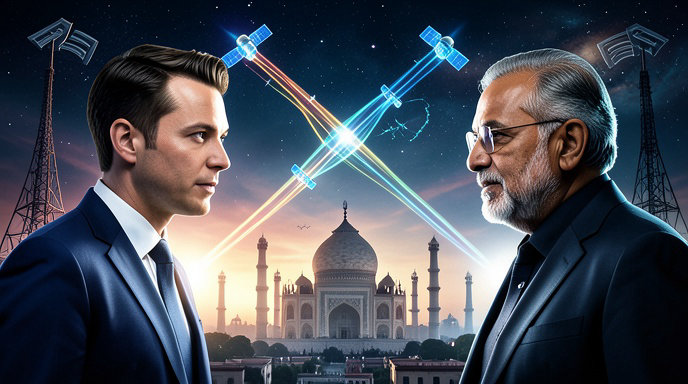
- Elon Musk has accused Reliance Jio and Indian telecom lobbies of pressuring regulators to block or delay Starlink, turning a licensing fight into a billionaire rivalry with Mukesh Ambani.
- Starlink has now secured a GMPCS licence and signed distribution deals with Jio and Airtel, but its commercial launch in India remains stalled over spectrum pricing, security compliance, and data-localisation rules.
- The outcome will decide India's satellite internet future, with JioSpaceFiber, Eutelsat OneWeb, and Amazon Kuiper all waiting on the same rules Starlink is fighting.
A Clash of Titans Over the Sky
It is the most high-stakes telecom battle India has seen in a decade, and it is not being fought with towers or fiber. It is being fought in orbit.
On one side is Elon Musk, the world's richest man, pushing to bring SpaceX's Starlink satellite internet service to India's 1.4 billion people. On the other is Mukesh Ambani, Asia's richest man and chairman of Reliance Industries, determined to protect Reliance Jio's dominance of 470 million-plus mobile subscribers.
For nearly four years, Starlink's India entry has been promised, delayed, banned, revived, and delayed again. And at the center of the delay, Musk argues, is not technology or demand - it is influence.
Musk Takes Aim at Ambani's Playbook
Musk first openly questioned Ambani's influence in late 2024, when India's Telecom Regulatory Authority of India, or TRAI, was deciding how to allocate satellite spectrum.
Ambani's Jio, along with the Cellular Operators Association of India, lobbied hard for an auction, the same lucrative model used for 5G airwaves that earned New Delhi over $11 billion. Musk called that move unprecedented and self-serving, arguing on X that auctioning satellite spectrum would hand an unfair advantage to local players with deeper political ties and block global competition.
Musk pushed instead for administrative allocation - a set-fee, shared-spectrum model used by the US, UK, and most of the world for satellite services. India's Telecom Minister Jyotiraditya Scindia ultimately sided with Musk on process, confirming under the Telecommunications Act of 2023 that satellite spectrum would be assigned administratively, not auctioned.
But winning that battle did not end the war. Jio pivoted to lobbying on price, urging TRAI to impose high spectrum charges and long lock-ins that analysts said were designed to make Starlink's business case in rural India unviable.
Why Starlink Is Still Grounded in India
As of October 2026, Starlink has cleared its biggest hurdle - receiving a Global Mobile Personal Communication by Satellite, or GMPCS, licence from the Department of Telecommunications in June 2025, followed by a commercial distribution pact with both Reliance Jio and Bharti Airtel in a stunning truce.
Yet commercial service is still not live nationwide. Three regulatory hurdles remain.
First, spectrum pricing. TRAI in May 2025 recommended a 4% adjusted gross revenue fee plus Rs 500 per urban subscriber per year, a formula Jio called far too low and Starlink called workable but still under review by the government.
Second, security clearance. In May 2025, the DoT issued 29 new national security mandates for satcom operators, including mandatory data localisation, Indian-based control centres, real-time interception capabilities, and domestic manufacturing timelines. Starlink has agreed in principle but is still building its two Indian gateways in Mumbai and Noida and proving compliance to the Inter-Ministerial Committee.
Third, IN-SPACe authorisation. India's space regulator must give final operational clearance for Starlink's Gen1 constellation over Indian airspace. That approval, expected in late 2025, has slipped into 2026 amid additional technical trials.
Jio vs Starlink: Partners in Public, Rivals in Private
The Jio-Starlink distribution deal surprised the industry, but insiders say it was tactical. By becoming Starlink's retailer, Jio ensures it gets a cut of every high-value rural and enterprise customer while it races to launch its own rival service, JioSpaceFiber in partnership with SES.
JioSpaceFiber, along with Bharti-backed Eutelsat OneWeb and Amazon's Project Kuiper, which received its own LOI in 2025, all want the same thing Starlink wants: cheap, long-term satellite spectrum. Jio has positioned its service as swadeshi - fully compliant, locally stored, and aligned with Digital India - contrasting it with Musk's image as an outsider demanding special treatment.
Industry executives say Jio fears a repeat of 2016, when it disrupted the market with free 4G. This time, Jio fears Musk could do the same from space with low-latency broadband priced at an estimated Rs 3,000 to Rs 4,200 per month, undercutting JioFiber and JioAirFiber in remote states where laying fiber costs a fortune.
What This Standoff Means for India's Internet Future
India has over 670 million people still without reliable broadband, most in villages where terrestrial networks do not reach. Satellite internet could connect schools, hospitals, railways, and the military in Ladakh, the Northeast, and island territories within months, not years.
If Starlink launches at scale in late 2026 or early 2027 as now expected, analysts project it could sign 2 to 5 million Indian subscribers by 2030, forcing Jio, Airtel, and BSNL to slash rural broadband prices and accelerate their own satellite fleets.
If it remains stalled, India risks falling behind Brazil, the Philippines, and Kenya, where Starlink is already operational, while preserving Jio's near-duopoly for longer.
Either way, the Musk vs Ambani fight has already rewritten India's telecom policy. It forced a new space-based communications framework, opened the door for Kuiper and OneWeb, and proved that the next telecom war will not be about who owns the ground - but who controls the sky.

Get All The Latest Updates Delivered Straight To Your Inbox For Free!