
Mirror Particle Unveils Human Behavior World Model at TechCrunch Disrupt Battlefield
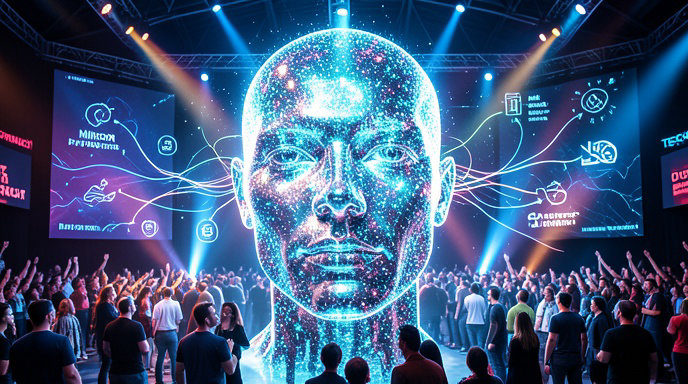
TL;DR
- Mirror Particle will debut in the TechCrunch Disrupt Startup Battlefield 200 with a foundation world model built from scratch specifically to predict human behavior.
- The startup argues that LLM role-play and synthetic personas fall short for market research and brand strategy because they reflect language patterns, not decision-making.
- Its approach points to a shift in consumer insights from surveys and focus groups to always-on AI simulation for testing products, messaging, and cultural trends.
Why Battlefield, Why Now
Mirror Particle is stepping out of stealth at a moment when every brand team is already experimenting with AI for consumer research, and growing frustrated with it. Selected for the TechCrunch Disrupt Startup Battlefield 200, the company is set to pitch live in San Francisco alongside hundreds of other early-stage startups vying for attention from investors, press, and enterprise customers.
But unlike the wave of AI wrappers for surveys and chat-based personas, Mirror Particle says it is building something deeper: a world model for human behavior. The goal is not a better chatbot that pretends to be a Gen Z shopper or a suburban dad. It's a simulation engine that can predict how different groups of people will react, choose, and evolve over time.
For TechCrunch Disrupt, which has historically been a launchpad for companies trying to define new categories, it's a fitting stage. Consumer insights is a multi-billion dollar industry still dominated by panels, polls, and focus groups, and it's ripe for disruption if simulation can prove trustworthy.
Beyond LLM Role-Play
The core of Mirror Particle's argument is simple: asking a large language model to role-play a customer doesn't work for serious market research.
LLMs are trained to predict the next word, not the next action. When you prompt one to act like a 34-year-old mom considering an EV, or a sneakerhead deciding between drops, it gives you a plausible-sounding stereotype drawn from its training data. It doesn't reason about budget constraints, social pressure, habits, identity, or trade-offs the way real humans do. The result is fluent, confident, and often wrong.
That flaw matters for brand strategy. Campaigns, pricing, packaging, and positioning live or die on nuance — why one message resonates in Austin but falls flat in Atlanta, why a price hike triggers backlash for one brand but loyalty for another. Mirror Particle contends that role-play collapses that complexity into caricature, leading teams to overconfident decisions based on AI-generated echo chambers.
The startup's pitch to researchers and CMOs is blunt: stop asking AI what a persona would say, start simulating what populations will do.
Built From Scratch To Predict Behavior
According to the company, Mirror Particle isn't fine-tuning an existing LLM with a market research prompt layer. It says its world model has been built from scratch to model human decision-making as a dynamic system.
While full technical details remain under wraps ahead of its Battlefield debut, the approach draws on behavioral science, economics, and complex systems rather than pure language modeling. Instead of generating text that sounds human, the model aims to simulate the underlying drivers of behavior — preferences, social influence, memory, context, and constraints — and then translate those states into observable outcomes like purchase intent, brand perception, or message resonance.
In practice, that could let a brand ask questions like: How will first-time buyers react if we raise prices 8% while adding a sustainability claim? Which creative concept actually shifts consideration among lapsed customers, not just likability? What happens when a competitor launches a week before us?
Rather than fielding a two-week survey for each question, teams could run thousands of simulated scenarios in hours, then validate only the strongest contenders with real humans.
What It Could Mean For Consumer Insights
If Mirror Particle delivers, the implications go far beyond faster surveys.
First, it would flip the research workflow. Today, insights teams start with a hypothesis, recruit respondents, wait for data, then debate what it means. A reliable behavior model would allow continuous experimentation — testing ideas, audiences, and cultural moments in simulation before spending a dollar on production or media.
Second, it could expand who gets heard. Traditional panels skew toward people who have time and incentive to answer surveys, often missing edge communities, emerging subcultures, or global audiences. Simulation promises broader coverage, though it also raises critical questions about representation and bias that Mirror Particle will need to address head-on.
Third, it signals a larger shift in AI: from models that talk like humans to models that act like populations. The same way weather models don't try to describe rain but predict it, human behavior world models aim to forecast collective outcomes. For brand strategy, product development, entertainment, and even policy, that could become foundational infrastructure.
The Road Ahead And The Skeptics
There are, of course, big hurdles. Predicting human behavior is notoriously hard, and the history of social simulation is littered with overpromises. Researchers will rightly ask: How is the model trained? What real-world behavioral data grounds it? How does it avoid amplifying stereotypes or missing cultural shifts? And will enterprises trust simulated respondents enough to bet million-dollar launches on them?
Mirror Particle will need to answer those questions on the Disrupt stage with more than vision — with demos, validation studies, and early customer proof showing its predictions beat both traditional methods and LLM personas.
But the timing is undeniable. Brands are drowning in data yet starved for understanding. Focus groups are too slow for TikTok-speed culture, and LLM chatbots are too shallow for board-level decisions. A world model purpose-built for how people actually behave offers a third path.
If Mirror Particle can prove it works at Battlefield, it won't just be pitching a startup. It will be pitching a new way to understand people themselves.

Get All The Latest Updates Delivered Straight To Your Inbox For Free!