
AI Robots vs. Humans in Transportation: The Future of Mobility A/B Testing
TL;DR
- Transportation companies are increasingly using controlled pilots, safety-driver comparisons, and operational A/B tests to measure autonomous systems against human performance.
- AI-powered vehicles and delivery robots can improve utilization, labor efficiency, and consistency, but rare-event safety, regulation, weather, cybersecurity, and public trust remain major obstacles.
- The most likely future is a hybrid mobility network in which robots handle predictable tasks while humans supervise, manage exceptions, and serve passengers directly.
Transportation is entering an unusual experimental phase. Instead of asking whether artificial intelligence can replace human workers in the abstract, mobility companies are increasingly testing the question in real operating environments: Can an autonomous vehicle complete the same routes, deliveries, warehouse movements, or passenger trips more safely, efficiently, and consistently than a person?
The comparison is not limited to robotaxis. It spans autonomous trucks, delivery vans, sidewalk robots, warehouse vehicles, airport systems, rail operations, maritime transport, and drones. In each case, companies are collecting operational data from human-led and machine-led workflows, then comparing outcomes such as cost per trip, completion rates, intervention frequency, energy use, safety events, and customer satisfaction.
This emerging form of A/B testing could become one of the defining management tools of the autonomous-mobility era. But transportation is not a conventional software product. A failed experiment does not merely produce a poor user experience; it can injure people, disrupt traffic, damage cargo, or undermine public confidence.
The New Mobility Experiment
In software, an A/B test might compare two versions of a webpage by randomly showing each version to different users. Transportation companies face a much more complicated challenge. Human drivers and autonomous systems cannot always be assigned identical conditions, and a test must account for traffic, weather, road design, vehicle type, passenger behavior, and time of day.
As a result, transportation A/B testing generally takes several forms:
- Parallel operations, in which human-driven and autonomous vehicles serve comparable routes or delivery zones.
- Shadow mode, in which an AI system makes decisions in the background while a human remains in control.
- Safety-driver trials, where a trained operator monitors an autonomous vehicle and can intervene.
- Before-and-after comparisons, measuring performance before and after automation is introduced.
- Matched-route analysis, comparing human and automated performance on similar trips, loads, and traffic conditions.
- Limited geofenced deployment, restricting autonomous operations to areas with favorable road layouts and predictable conditions.
The goal is not simply to determine whether a robot can finish a trip. Companies must also establish whether it can do so at a commercially meaningful cost and with a safety record that regulators and the public will accept.
Where the Tests Are Happening
Robotaxis remain the most visible example. Waymo has expanded commercial autonomous ride-hailing in selected U.S. cities, while other developers, including Zoox and autonomous-vehicle partnerships involving major automakers and technology companies, continue to test vehicles in restricted environments. These services generate comparisons between autonomous fleets and conventional ride-hailing drivers across wait times, trip completion, passenger ratings, braking events, and operating costs.
Autonomous trucking is another major testing ground. Companies such as Aurora, Torc Robotics, Kodiak Robotics, Gatik, Waabi, and other developers have pursued highway freight, middle-mile delivery, and fixed-route logistics. Trucks are particularly attractive for automation because long-haul routes are repetitive, labor-intensive, and often easier to constrain than dense urban driving.
Delivery is even more fragmented. Nuro has developed autonomous delivery vehicles, while companies such as Starship Technologies and Serve Robotics operate small sidewalk delivery robots in selected locations. Drone operators, including Zipline and other logistics providers, are testing automated aerial delivery for medical supplies, food, and retail orders.
In warehouses and distribution centers, robots already work alongside people at large scale. Autonomous mobile robots move inventory, retrieve goods, and optimize warehouse traffic. Here, the comparison is often less about replacing an entire job and more about measuring whether machines can reduce walking time, increase order throughput, or make physically demanding work safer.
What Companies Actually Measure
The most important metrics differ by transportation segment, but several appear across nearly all trials.
Safety is the first. Companies track collisions, near misses, emergency braking, unsafe lane changes, hard stops, road-rule violations, and human interventions. A simple incident count is not enough, because autonomous vehicles may travel more miles than human-operated vehicles or operate in different conditions. Analysts therefore examine rates per mile, per trip, per operating hour, or per passenger journey.
Efficiency is another central measure. Fleets compare average trip duration, vehicle utilization, empty miles, fuel or electricity consumption, loading time, and the number of trips completed per shift. For trucking, the ability to operate for longer periods without driver-hours limitations can be economically significant. For robotaxis, vehicle utilization and reduced downtime are critical to the business model.
Labor economics receive close scrutiny. A company may compare the cost of a human driver, including wages, benefits, recruitment, training, insurance, and downtime, with the cost of an autonomous system, including hardware, software, remote assistance, maintenance, mapping, data processing, and regulatory compliance.
Customer experience is also part of the experiment. Passengers may evaluate comfort, perceived safety, ride smoothness, pickup accuracy, and the availability of human support. Delivery customers may care more about arrival windows, package security, communication, and whether a robot can navigate the final few meters to a door.
Reliability can be more important than peak performance. A system that completes 99 percent of trips but requires expensive human intervention on the remaining 1 percent may not be ready for broad deployment. Companies increasingly track disengagements, remote-assistance requests, stalled vehicles, blocked robots, and situations that require a person to take over.
Why Robots Can Win
AI-powered transport systems offer several potential advantages over human workers.
Machines do not become tired, distracted, impatient, or intoxicated. They can maintain continuous attention, react quickly to sensor inputs, and follow operating procedures consistently. A connected fleet can also share information about traffic, road hazards, weather, and vehicle performance.
Automation may improve asset utilization. A commercial truck or delivery vehicle can potentially operate for longer hours, while robotaxis can be repositioned based on real-time demand. In warehouses, robots can work continuously in environments that are monotonous or physically taxing for employees.
The economics may improve as systems mature. Software updates can enhance the behavior of an entire fleet, while vehicle data can help operators identify recurring problems and optimize routes. Electric autonomous vehicles may further reduce fuel and maintenance costs in applications where duty cycles are predictable.
Automation could also address labor shortages. Freight carriers, delivery operators, and transit agencies in many markets have struggled to recruit and retain drivers. Robots are not a complete substitute for skilled workers, but they may reduce the number of people required for routine transport tasks and allow existing employees to focus on more complex responsibilities.
Where Humans Still Have the Edge
Human drivers remain remarkably capable in unusual situations. They can interpret ambiguous gestures, negotiate informally with other road users, respond to social cues, and improvise when roads, loading zones, or traffic patterns change unexpectedly.
A human can recognize that a construction worker is waving traffic through a temporary closure, understand that a delivery recipient is elderly or injured, or decide that a risky maneuver should be avoided despite a navigation system’s recommendation. These judgments are difficult to encode because they depend on context, experience, and common sense.
Humans also handle responsibility across the entire service. A driver may assist a passenger with luggage, secure a fragile shipment, communicate with a dispatcher, or provide reassurance during an emergency. An autonomous vehicle may perform the driving task well while still requiring a network of people to handle everything around it.
This is why many commercial systems are not eliminating human labor outright. Instead, they are reallocating it. Drivers may become remote supervisors, fleet technicians, customer-support specialists, safety operators, or exception managers.
The Safety Problem Is Statistical
Autonomous-vehicle developers often emphasize lower collision rates or better performance on average. Regulators and safety researchers must also examine rare but severe events.
A human driver may make routine mistakes frequently, while an autonomous system may perform well for millions of miles and then fail in a highly unusual scenario. Both patterns matter. A credible safety comparison must measure ordinary driving behavior and the system’s ability to manage edge cases.
Testing is complicated by the fact that the most dangerous events are relatively rare. Companies cannot simply wait for enough real-world crashes to generate statistically conclusive evidence. They use simulation, closed-course testing, scenario replay, high-definition maps, synthetic data, and accelerated testing to expose systems to unusual conditions.
Even those methods have limitations. Simulation may fail to capture the unpredictability of human behavior. Closed courses cannot fully reproduce public-road complexity. A system that performs well in sunny, dry conditions may behave differently in heavy rain, snow, dust, glare, or poorly marked construction zones.
The Human-in-the-Loop Compromise
A common intermediate model places a human safety driver inside the vehicle or maintains a remote operations center capable of assisting when the autonomous system encounters uncertainty.
This approach can make deployment safer, but it changes the economics. A vehicle that requires constant human attention may not deliver the labor savings promised by full autonomy. Remote operators may supervise multiple vehicles, yet the number depends on how often assistance is needed and how complex each intervention becomes.
There is also a risk of automation complacency. A safety driver who rarely intervenes may become less attentive over time, even though the system may suddenly encounter a situation requiring an immediate response. Companies must therefore design monitoring systems, training programs, and escalation procedures that keep human supervisors engaged.
The issue is especially sensitive in autonomous trucking and public transit, where a remote operator may be responsible for a vehicle carrying heavy cargo or many passengers. The technical ability to intervene is not the same as the practical ability to respond quickly enough.
A/B Testing Can Produce Misleading Results
Comparing robots with people sounds straightforward, but the quality of the result depends on how the test is designed.
Autonomous systems are often launched first in favorable locations with good weather, mapped streets, moderate traffic, and carefully selected routes. Human drivers, by contrast, may be evaluated across a much broader range of conditions, including difficult shifts and unfamiliar roads. An apparently superior robot performance may therefore reflect a friendlier operating environment rather than a more capable system.
The reverse can also happen. A pilot may place autonomous vehicles in especially difficult areas to demonstrate robustness, while human drivers benefit from years of local experience. Small sample sizes can exaggerate both success and failure.
Companies must also account for selection bias. Customers willing to ride in an autonomous vehicle may have different expectations from those who prefer a human driver. Delivery robots may be used for short, low-risk orders, while humans handle heavy, urgent, or complicated deliveries.
Independent evaluation is therefore essential. Regulators, insurers, researchers, labor organizations, and local communities need access to meaningful safety and performance data rather than promotional averages.
The Workforce Question
Automation will not affect every transportation job in the same way. Long-haul driving, warehouse picking, dispatch, parking, and routine delivery may face greater exposure than jobs requiring complex interpersonal interaction or irregular physical work.
The transition could produce both displacement and new employment. Fleets will need technicians, software specialists, remote operators, safety analysts, cybersecurity professionals, mapping teams, and customer-service workers. Existing drivers may be able to move into these roles, but only if companies and governments provide training and credible career pathways.
The timing is equally important. Automation rarely arrives as a single event in which every human worker is replaced. More often, companies introduce technology gradually, reduce hiring, change routes, increase worker productivity, or assign one employee to oversee more vehicles.
That gradual process can still have major effects on wages, bargaining power, scheduling, and regional employment. A city may gain more efficient mobility while losing stable driving jobs. The social value of automation will depend partly on how those gains are distributed.
Regulation Is Becoming Part of the Product
Autonomous mobility companies must design not only for technical performance but also for regulatory acceptance. Rules vary by jurisdiction and may cover testing permits, driver requirements, reporting obligations, cybersecurity, accessibility, insurance, data protection, and emergency response.
The regulatory environment is evolving unevenly. Some regions have encouraged autonomous testing and commercial deployment, while others have imposed stricter requirements after crashes, traffic disruptions, or public opposition. A system that is legally deployable in one city may require substantial changes elsewhere.
Incident reporting is particularly important. Transportation providers must establish who is responsible when an automated vehicle makes a decision, when a remote operator fails to intervene, or when a software update changes fleet behavior. Liability questions involving manufacturers, fleet operators, software suppliers, and human supervisors remain unsettled in many markets.
Public Trust May Decide the Outcome
Technical performance alone will not determine whether autonomous transportation succeeds. People must also feel comfortable sharing roads and public spaces with machines.
Trust can be damaged by a small number of highly visible incidents, even if the overall statistical safety record is strong. A stranded robot, an unexpected stop, or a vehicle blocking emergency access can generate more public attention than thousands of successful trips.
Transparency matters. Companies that explain system limitations, disclose safety events, and provide accessible customer support may build confidence more effectively than those that present autonomy as flawless. Cities also need a voice in deciding where robots operate, how they affect sidewalks and traffic, and which communities receive the benefits.
The Future Will Be Hybrid
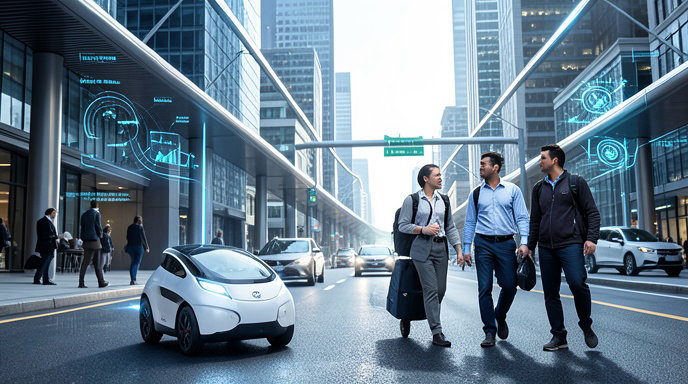
The most realistic outcome is not a clean victory for robots or humans. Transportation is likely to develop into a layered system in which automation handles predictable, repetitive, and highly measurable tasks while people manage exceptions and provide social support.
A robot may drive the highway portion of a freight journey while a human handles urban delivery. An autonomous shuttle may operate on a fixed route while a transit employee assists passengers. A warehouse robot may move inventory while a human worker handles quality control, unusual orders, and customer issues.
A/B testing will help determine where those boundaries should be drawn. The winning system will not necessarily be the one that removes the most workers. It may be the one that combines machine consistency with human judgment at the lowest total risk and cost.
What Comes Next
Over the next several years, transportation companies are likely to move from demonstration projects toward more disciplined operational measurement. Fleets will compare autonomous and human workflows over longer periods, in more weather conditions, and across a wider variety of neighborhoods and freight corridors.
The most important tests will evaluate not just whether a robot can drive, fly, or deliver, but whether the complete service is better. That includes maintenance, charging, dispatch, customer assistance, emergency response, insurance, labor transitions, accessibility, and environmental impact.
The central question is therefore changing. It is no longer simply whether artificial intelligence can perform a transportation task. It is whether an AI-enabled mobility network can deliver safer, more affordable, more reliable, and more equitable transportation than the human-centered systems it aims to transform.
That answer will emerge one route, one delivery zone, one warehouse, and one carefully designed experiment at a time.

Get All The Latest Updates Delivered Straight To Your Inbox For Free!