
Dutch Privacy Authority Warns Against “Pervert Glasses” Over Privacy and Safety Risks
TL;DR
- The Dutch Data Protection Authority is warning that camera-equipped smart glasses can record people discreetly and collect sensitive personal information without meaningful consent.
- The regulator says inaccurate AI-generated descriptions and facial or environmental analysis could cause serious privacy, discrimination and safety problems.
- Users, manufacturers and businesses are urged to make recording obvious, limit data collection and avoid using the glasses in situations where people may be vulnerable or unable to object.
WHY DUTCH REGULATORS ARE RAISING THE ALARM
Smart glasses that can take photographs, record video, listen to conversations and use artificial intelligence to analyse what the wearer sees are attracting increasing scrutiny in the Netherlands.
The Dutch Data Protection Authority, known as the Autoriteit Persoonsgegevens, has warned that these products can create a surveillance environment in which people are recorded without realising it. The regulator’s concerns are particularly focused on glasses that look like ordinary eyewear and can capture images or audio from close range.
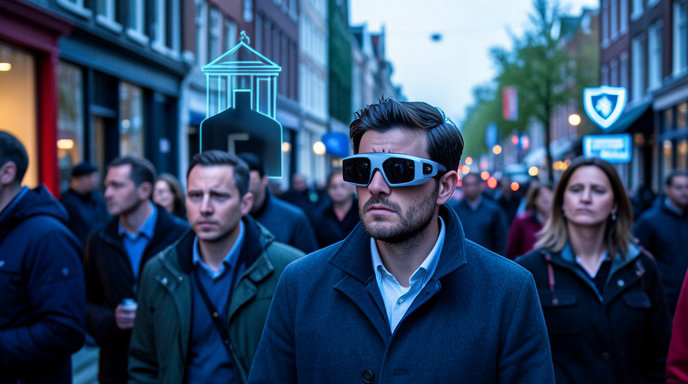
The technology has sometimes been described in blunt terms as “pervert glasses” because of the risk that wearers could use concealed cameras to film people in private, intimate or otherwise sensitive situations. The phrase also reflects a broader concern: by making recording nearly invisible, smart glasses can undermine the basic social cues people rely on to know when they are being observed.
Unlike a conventional camera or smartphone, the glasses may be pointed at someone simply because the wearer is looking at them. That makes it harder for bystanders to identify when recording is taking place, who is responsible and how the resulting data will be used.
THE CONSENT PROBLEM
European data-protection law generally requires a lawful basis for processing personal data, and additional safeguards may apply to sensitive information such as health details, biometric data, political views or information about a person’s private life.
In practice, however, people encountered by a smart-glasses wearer may have little opportunity to provide informed consent. A small recording light may be difficult to see, especially outdoors, in crowded places or when the glasses are partially obscured. Even when a person notices the light, they may not understand whether the device is taking a still image, recording video, capturing audio or sending information to a cloud-based AI service.
The Dutch regulator’s warning highlights the gap between formal consent and genuine choice. A person may technically be able to object, but only after being recorded. In workplaces, schools, hospitals, shops or public transport, refusing may also be impractical or socially difficult.
The issue becomes more complicated when recordings are automatically uploaded for transcription, translation, image recognition or AI assistance. A single interaction can involve several parties: the wearer, the glasses manufacturer, a cloud provider and third-party software companies. Each may process the information for different purposes.
AI CAN MAKE A BAD RECORDING WORSE
Recording someone without permission is only one part of the risk. Smart glasses can also interpret what they see and hear, and those interpretations may be wrong.
AI systems can misidentify people, misread gestures, misunderstand conversations or generate inaccurate descriptions of an individual’s appearance or behaviour. Audio captured in a noisy environment may be transcribed incorrectly, while a camera may mistake an object, medical condition or facial expression.
An inaccurate output can spread quickly if it is saved, shared or used to make a decision about someone. A mistaken identification could lead to embarrassment, harassment or confrontation. In more serious circumstances, it could influence employment, access to services, policing or personal safety.
The glasses may also collect information about people who never knowingly interact with the device. A face, voice, home interior, licence plate, computer screen or conversation can become part of a dataset without the subject understanding that it has been captured.
SAFETY RISKS BEYOND PRIVACY
The regulator’s concerns extend beyond data protection. A person who believes they are being secretly filmed may react angrily or attempt to confront the wearer. That creates the possibility of unsafe situations, particularly in crowded locations or during sensitive encounters.
There are also risks for people who are vulnerable, including children, victims of domestic abuse, patients and individuals in crisis. Secret recordings could expose their identity, location or personal circumstances. Once shared online, such material may be difficult or impossible to remove completely.
Wearers themselves may face danger if they become distracted by voice assistants, navigation prompts or augmented-reality features while walking, cycling or driving. Recording can also encourage users to behave as if ordinary privacy boundaries do not apply, especially when the device offers instant search, recognition or real-time advice.
The possibility of misuse is not limited to sexual or voyeuristic recording. Smart glasses could be used for covert workplace monitoring, stalking, filming confrontations, gathering intelligence about buildings or collecting information from documents and screens.
WHAT THE AUTHORITY WANTS USERS AND COMPANIES TO DO
The Dutch warning places responsibility on more than the individual wearer. Manufacturers and service providers need to build privacy protections into the products before they reach consumers.
That can include making recording indicators highly visible, providing audible or physical signals that cannot easily be disabled, limiting automatic uploads and giving people practical ways to request deletion. Companies should also explain clearly what data is collected, where it is processed, how long it is retained and whether it is used to train AI systems.
Data minimisation is another central safeguard. Glasses should not continuously record or retain more information than is necessary for a specific function. Sensitive features, such as facial recognition or the identification of individuals in a live view, require especially careful scrutiny and may be restricted by European rules.
Businesses using smart glasses should conduct privacy and safety assessments before deploying them. Employees and customers should be told when the devices are in use, and organisations should establish rules covering recording, storage, access and disclosure.
For consumers, the practical advice is straightforward: do not record people in private or sensitive settings, respect requests to stop, avoid uploading material unnecessarily and treat AI-generated results as potentially unreliable.
A TEST FOR THE NEXT GENERATION OF WEARABLES
Smart glasses are being promoted as a more natural alternative to smartphones. They can provide navigation, translation, accessibility tools, hands-free communication and assistance for people with visual or other disabilities. Those potential benefits do not eliminate the need for safeguards, but they show why regulators are focusing on responsible design rather than simply rejecting the technology.
The central challenge is visibility. Smartphones make recording relatively obvious; glasses can make it ambient and continuous. If people cannot tell when they are being observed, they lose the ability to make informed decisions about participating in a conversation or entering a space.
The Dutch authority’s warning therefore arrives at a crucial moment for the wearable-computing industry. As cameras and AI become smaller, cheaper and more capable, privacy protections will need to become more noticeable, not less.
Without clear signals, strict limits and meaningful accountability, smart glasses risk turning everyday environments into places where everyone is a potential subject of covert recording. The technology may be marketed as convenient and intelligent, but public acceptance will ultimately depend on whether people can still feel safe when someone nearby is wearing a pair.

Get All The Latest Updates Delivered Straight To Your Inbox For Free!