
Google AI Mode Integrates Drive and Wallet for Personalized Search Results
TL;DR
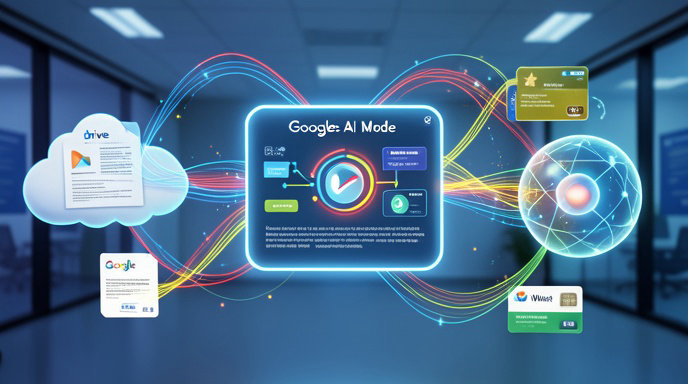
- Google is expanding AI Mode’s Personal Intelligence features to use information from Google Drive, Google Wallet, and the Gemini app when answering Search questions.
- The integration is designed to produce more useful, context-aware results, such as finding files, recalling trip details, or drawing on previous Gemini conversations.
- The convenience comes with important privacy questions, and Google says the connections are optional and controlled through user settings.
From Web Search to Personal Context
AI Mode is Google’s conversational Search experience, built to handle longer, more complex questions through an interface powered by generative AI. Rather than presenting only a list of links, it can summarize information, break a question into multiple searches, and provide follow-up answers.
Personal Intelligence adds another layer by allowing AI Mode to use information from connected Google services. A user might ask for help organizing a project and have Search identify relevant documents in Drive. Someone planning a trip could ask about an upcoming journey and receive an answer informed by boarding passes, event tickets, or other eligible items stored in Wallet.
The goal is to reduce the need to search through several separate apps. Instead of opening Drive to find a document, Wallet to check a reservation, or Gemini to review an earlier conversation, users can ask a question in one place.
Drive Adds a Searchable Personal Knowledge Layer
Google Drive contains a wide range of information that is invisible to public Search, including work documents, school assignments, presentations, spreadsheets, PDFs, and personal notes.
Connecting Drive to AI Mode could make that information easier to retrieve. Users may be able to ask questions about documents, locate files based on natural-language descriptions, or have Search summarize information spread across multiple files.
That capability could be especially useful when a person does not remember a file’s exact name. A request such as “Find the presentation I made about next quarter’s product plans” is more natural than searching for a precise filename or folder location.
The usefulness of the feature will depend heavily on how Google handles permissions and document boundaries. A personal account may contain files with different levels of sensitivity, while shared Drive documents can involve colleagues, clients, or family members. AI Mode must therefore distinguish between material a user can access and material the user is authorized to have summarized or surfaced in a particular context.
Wallet Connects Search to Real-World Plans
Google Wallet brings a different type of personal information into the experience. The app can hold boarding passes, event tickets, loyalty cards, transit passes, vaccination records in some regions, and other digital credentials.
With Wallet integration, AI Mode could potentially answer practical questions about upcoming travel or events without requiring users to manually open the app. A question about an itinerary, venue, departure time, or ticket could be answered using relevant passes and reservations already available in the user’s Wallet.
The integration could also make Search more timely. Wallet information is often tied to dates and locations, giving Google a way to connect a user’s question with an upcoming event or trip.
However, these details are highly sensitive. Travel plans can reveal where a person will be, while tickets and passes can expose event attendance, memberships, or other aspects of a user’s life. That makes clear consent and precise controls particularly important for Wallet-related features.
Gemini Conversations Become Part of the Context
Google is also connecting AI Mode with the Gemini app. This could allow Search to draw on earlier Gemini conversations when a user asks a follow-up question or returns to a subject discussed previously.
For example, a user who asked Gemini to compare laptops could later ask Search to find current deals or explain a technical specification. Someone who used Gemini to plan a vacation might ask a new question about the trip without restating every preference.
The connection could make Google’s AI products feel more continuous. Instead of treating Search and Gemini as separate destinations, Google is positioning them as parts of a broader assistant that can carry context between services.
That continuity also creates a more complicated data picture. A conversation with Gemini may contain personal preferences, financial considerations, health-related questions, work details, or other information that a user did not expect to appear in a Search response. The value of persistent context will depend on whether users understand when it is being used and can easily control it.
Personalization Without Losing User Control
Google has emphasized that Personal Intelligence is optional. Users must choose to connect eligible services, and the company provides settings for managing or disconnecting those integrations.
The controls are important because personalization is not equally desirable in every situation. Some people may want AI Mode to use their Drive files for work but not their Wallet data. Others may prefer to keep Gemini conversations separate from Search altogether.
Ideally, users should be able to see which connected source contributed to an answer, disable individual services, review stored activity, and delete relevant data. They should also be able to ask questions without personal connections being used at all.
The distinction between personalization and surveillance will largely depend on how visible those controls are. If a response relies on a private file or a Wallet pass, users should not have to guess where the information came from.
Privacy and Security Implications
The expansion increases the amount of personal data that Google’s AI systems may use to generate answers. Drive can contain confidential documents, Wallet can reveal movement and purchases, and Gemini can preserve a detailed record of a user’s interests and questions.
Google must also address the risk of accidental disclosure. An AI system could expose sensitive information in a response displayed on a shared device, misunderstand which file a user intended to reference, or combine details from different services in a way the user did not anticipate.
Accuracy presents another challenge. Personal data can be outdated, incomplete, or ambiguous. A canceled ticket may remain visible in an account, a Drive document may contain old information, and a Gemini conversation may reflect an earlier plan that has since changed. Users will need to treat AI-generated answers as helpful summaries rather than authoritative records.
There are also broader questions about how personal data is processed and retained. Google’s policies distinguish between information used to provide a feature and information used to improve products, but users will want clear explanations of those differences as AI Mode becomes more deeply connected to their accounts.
A More Useful Search—and a More Powerful Google
The integration gives Google a significant advantage over standalone AI assistants. Google already operates many of the services where people store information, plan activities, communicate, and search for answers. Connecting those services allows the company to build a more capable assistant without requiring users to import their data manually.
For users, the benefit is convenience. Search could become a single interface for finding a file, checking an itinerary, revisiting an AI conversation, and researching information from the open web.
For Google, the feature strengthens the relationship between Search and the rest of its ecosystem. The more useful AI Mode becomes with connected personal data, the more difficult it may be for users to move between competing services.
The approach also increases Google’s responsibility. A personalized answer is valuable only if it is accurate, understandable, and delivered within boundaries that users can control.
Availability and What to Expect
Google’s Personal Intelligence capabilities are being introduced as an expansion of AI Mode rather than as a universal replacement for traditional Search. Availability may vary by country, account type, product, device, and rollout stage.
Users who receive access are expected to opt in through Google’s AI Mode or related account settings, where they can manage connections to supported services. Google may expand the feature over time as it evaluates quality, privacy safeguards, and user demand.
The initial appeal will likely come from simple tasks—finding a document, checking a reservation, or continuing an earlier AI conversation. The longer-term significance is greater: Google is attempting to make Search aware not only of the public internet, but also of the user’s digital life.
Whether that becomes genuinely helpful will depend on the balance between context and control. If Google can make personalization transparent and selective, AI Mode could become a powerful everyday tool. If the boundaries remain unclear, the same integration could reinforce concerns about how much personal information users are willing to place inside an AI-powered Search box.

Get All The Latest Updates Delivered Straight To Your Inbox For Free!