
Jensen Huang Senate Testimony: What to Know About the Nvidia CEO Allegation
TL;DR
- No credible public evidence confirms that Nvidia CEO Jensen Huang has been scheduled to testify before the U.S. Senate.
- Claims that Huang was “reinstated” appear unsupported; Nvidia has not publicly announced that he was removed from his role.
- Huang could face future congressional scrutiny over artificial intelligence, semiconductor exports and national security, but potential scrutiny is not the same as a confirmed hearing.
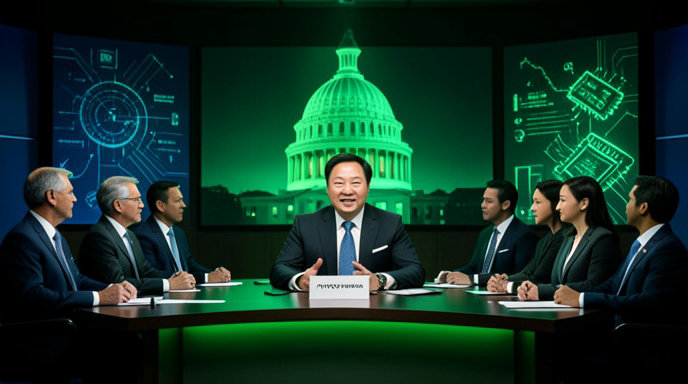
The claim that Nvidia CEO Jensen Huang has been “reinstated” and is now scheduled to testify before the U.S. Senate appears to combine unrelated or unverified assertions.
As of November 24, 2026, there is no reliable public confirmation of a Senate hearing featuring Huang that matches the allegation. Neither Nvidia nor publicly available congressional announcements have established that the company’s chief executive was removed and later restored to his position. The central premise therefore remains unsubstantiated.
That distinction matters. Nvidia has become one of the most politically significant technology companies in the world, and Huang is increasingly involved in discussions about artificial intelligence, advanced computing and semiconductor policy. Those facts make a congressional appearance plausible in the abstract, but they do not prove that one has been scheduled.
What the “reinstated” claim gets wrong
Jensen Huang has served as Nvidia’s chief executive since the company was founded in 1993. Nvidia’s public corporate materials have continued to identify him as chairman and CEO.
There has been no well-established public announcement indicating that Huang was dismissed, suspended or otherwise removed from the position before being reinstated. A change in board duties, a correction to a corporate filing, a social-media rumor or a fabricated news report could potentially be the source of the wording, but none of those possibilities should be treated as evidence without documentation from Nvidia or a formal regulatory filing.
A genuine leadership reinstatement would normally generate an official company statement, regulatory disclosure or extensive coverage from major business-news organizations. No such confirmed record has been identified in connection with the allegation.
Is a Senate hearing actually scheduled?
A confirmed Senate hearing generally leaves a public trail. Relevant information may appear in a committee hearing notice, a committee calendar, an official witness list, a congressional press release or testimony submitted to the committee.
The allegation does not appear to be supported by that type of documentation. There is no confirmed public evidence that Huang has received a formal Senate invitation, agreed to testify or been listed as a witness for a specific hearing.
It is also important to distinguish between a congressional briefing, a private meeting, a written request for information and sworn testimony at a public hearing. Executives often meet with lawmakers or staff without appearing at a televised hearing. Describing such contact as “Senate testimony” would be misleading.
Why Huang could attract congressional attention
Even without a confirmed hearing, Huang is a likely subject of congressional interest because Nvidia supplies many of the advanced graphics processors used to train and operate modern AI systems.
Several issues could prompt lawmakers to seek information from him:
AI infrastructure and market power
Nvidia’s chips and software have made the company a central supplier to cloud providers, research institutions and AI developers. Lawmakers may ask whether Nvidia’s position creates competition concerns, whether customers are overly dependent on its software ecosystem and how the company manages supply allocation.
Export controls and China policy
Nvidia has faced repeated changes to U.S. rules governing the sale of advanced chips to China and other markets. A Senate committee could question Huang about compliance, product redesigns intended to meet export rules and the risk that restricted computing capabilities could reach Chinese military or surveillance organizations.
National-security implications
Advanced AI hardware is increasingly treated as strategic infrastructure. Questions could focus on whether the United States can maintain a durable lead in chip design and manufacturing, how much production depends on overseas foundries and whether companies are prepared for supply-chain disruption.
Energy and data-center demand
The expansion of AI data centers is increasing demand for electricity, cooling systems and networking equipment. Huang could be asked about the environmental and infrastructure costs of large-scale computing, as well as the role of Nvidia’s products in improving energy efficiency.
Corporate governance and investor disclosures
Nvidia’s rapid growth has made its public statements closely watched by investors. Lawmakers could examine how the company describes demand, supply constraints, customer concentration, export restrictions and the risks associated with the AI market.
A Senate appearance would not necessarily mean wrongdoing
Even if Huang were invited to testify, that would not by itself indicate that Nvidia or its CEO had violated the law.
Congress routinely summons corporate leaders to gather information, examine an industry or publicly debate policy. Executives may be asked to explain business practices, provide technical context or respond to concerns raised by regulators and lawmakers.
A hearing could be voluntary, compelled through a subpoena or conducted as part of a broader investigation. Those situations carry different legal and political implications. Reporting should not blur them together.
The political stakes
A hearing involving Huang would likely attract attention from both parties, although the areas of emphasis could differ.
Some lawmakers would likely focus on preserving America’s lead in AI, expanding domestic semiconductor manufacturing and preventing advanced technology from strengthening strategic competitors. Others could emphasize competition, corporate concentration, labor impacts, energy consumption and the distribution of AI’s economic benefits.
Huang’s unusual position—leading a company whose market value and strategic importance have expanded at extraordinary speed—would make the event politically significant even if it produced no formal enforcement action.
How to evaluate the allegation
Readers should be cautious when a report uses phrases such as “reinstated,” “ordered to testify” or “scheduled before the Senate” without identifying a committee, hearing date or official source.
The most reliable verification points would include:
- An official Senate committee calendar or hearing notice
- A congressional press release naming Huang as a witness
- A formal Nvidia statement
- A Securities and Exchange Commission filing, where relevant
- Direct reporting from established news organizations that identifies primary documents or named officials
Screenshots, anonymous social-media posts and articles that cite no committee or company records are not sufficient to establish that a hearing exists.
What is confirmed—and what is not
Confirmed: Huang remains Nvidia’s prominent chief executive and the company is deeply involved in policy debates over AI chips, export controls, national security and computing infrastructure.
Not confirmed: That Huang was removed from his position and later reinstated.
Not confirmed: That he has been scheduled to testify before the Senate.
Plausible but speculative: That lawmakers may seek testimony from Huang in the future because of Nvidia’s importance to the AI supply chain and U.S. technology policy.
The bottom line
The Senate-testimony allegation should be treated as unverified rather than as breaking news. Nvidia’s importance makes congressional scrutiny entirely plausible, but plausibility is not confirmation. Until a Senate committee, Nvidia or another authoritative source publishes a hearing notice or witness confirmation, there is no solid basis for saying that Jensen Huang has been scheduled to testify or that he was recently reinstated as Nvidia’s CEO.

Get All The Latest Updates Delivered Straight To Your Inbox For Free!