
Trump Urges Nvidia Board to Bring Back CEO Jensen Huang
TL;DR
- President Donald Trump reportedly urged Nvidia’s board to support Jensen Huang’s return, though the alleged conversation and its details have not been independently verified.
- Huang remains Nvidia’s co-founder and chief executive in publicly established company history; any leadership change would have major consequences for the chipmaker’s AI strategy.
- The episode highlights the growing overlap between U.S. technology policy, semiconductor competition and presidential influence over Silicon Valley.
A Reported Intervention at Nvidia
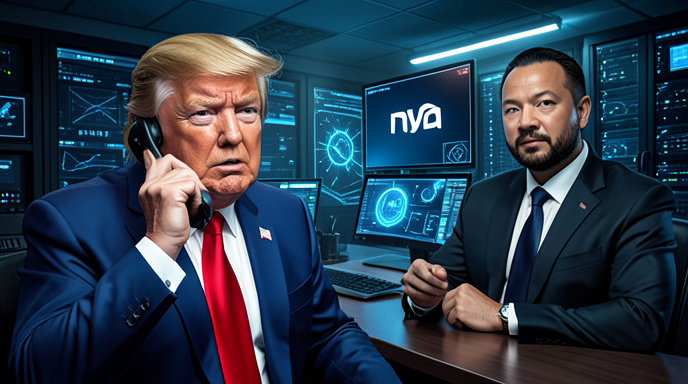
President Donald Trump is reported to have contacted Nvidia’s board and claimed that he persuaded directors to support Jensen Huang’s return as chief executive. The account, if confirmed, would represent an extraordinary intervention by a U.S. president in the leadership of one of the world’s most strategically important technology companies.
There is an important caveat: publicly established information identifies Huang as Nvidia’s co-founder, president and chief executive. The reported “return” therefore requires clarification. It could refer to a hypothetical leadership transition, a temporary departure, a proposed change in executive responsibilities or an inaccurate description of events.
No responsible account of the episode can treat the alleged call as established fact without confirmation from Nvidia, the White House or people directly familiar with the conversation.
Why Jensen Huang Matters to Nvidia
Huang is more than Nvidia’s chief executive. He is the company’s most visible strategist, principal public advocate and central link between its hardware, software and developer ecosystems.
Under his leadership, Nvidia transformed from a graphics-chip specialist into the dominant supplier of accelerators used to train and operate artificial-intelligence systems. Its data-center business became the company’s financial engine, while its CUDA software platform helped make Nvidia hardware difficult for customers and developers to replace.
That transformation has made Huang unusually important to investors and policymakers. Any suggestion that he might leave, return or assume a different role would immediately raise questions about Nvidia’s succession plans, product roadmap and ability to maintain its lead over rivals.
The Leadership Questions
If Trump did urge Nvidia’s board to bring Huang back, the board would face questions about the circumstances behind the intervention and the authority under which it was made.
Corporate directors are responsible for appointing and overseeing executives, not elected officials. A president may exert considerable political and economic influence, particularly when national-security interests are involved, but a board’s formal duty remains to the company and its shareholders.
The episode could also expose weaknesses in Nvidia’s succession planning. A company whose strategy is closely associated with one leader must demonstrate that its competitive advantage rests on durable technology, talent and institutions rather than on a single personality.
Investors would likely seek clarity on several issues:
- Whether Huang had actually left or changed roles
- Whether the board had considered replacing him
- Who would oversee day-to-day operations during any transition
- How Nvidia’s product and capital-allocation plans would be affected
- Whether the company’s succession process had been influenced by political pressure
Implications for Nvidia’s AI-Chip Strategy
Nvidia’s position in artificial intelligence depends on more than its latest graphics processors. Its competitive system includes high-speed networking, advanced packaging, system design, software libraries, cloud partnerships and the CUDA development platform.
A leadership change could affect how aggressively Nvidia expands beyond individual chips. Huang has pushed the company toward full data-center systems and increasingly broad AI infrastructure, including networking equipment, enterprise software and partnerships with major cloud providers.
A return by Huang, if the phrase accurately describes the situation, could reassure customers that Nvidia intends to maintain its current strategic direction. It could also signal that the board views continuity as more important than a dramatic succession.
At the same time, political involvement could complicate Nvidia’s commercial decisions. The company must balance access to the Chinese market against U.S. export controls, while continuing to supply American technology companies and government-backed AI projects. Decisions about which products can be sold abroad are already closely linked to national security.
Washington and Silicon Valley Draw Closer
The reported call reflects a broader shift in the relationship between Washington and the technology industry. Artificial intelligence has become a central issue in economic policy, defense planning and competition with China. As a result, companies such as Nvidia occupy a position that is both commercial and geopolitical.
The federal government has a direct interest in advanced semiconductor supply chains. It also has tools that can affect Nvidia’s business, including export restrictions, procurement decisions, industrial subsidies and national-security reviews.
That influence gives presidents more leverage over major technology companies. But it also creates risks. If corporate boards appear to act in response to political demands, investors may question their independence. Other technology executives could become more cautious in dealing with the administration, while foreign customers could interpret leadership changes as evidence that U.S. companies are subject to political intervention.
The issue is not limited to Nvidia. Similar tensions are likely to emerge at other companies involved in AI models, cloud computing, semiconductor manufacturing and defense technology.
What Needs to Be Verified
Several core details remain essential to establishing what happened:
- Whether Trump actually spoke with Nvidia’s board
- Whether Huang had departed, planned to depart or was being considered for a different position
- Whether the board voted on any leadership proposal
- Whether Nvidia or the White House will issue a statement
- Whether the account originated with a direct participant or with an intermediary
Until those questions are answered, the claim should be treated as a report rather than a confirmed corporate event.
A High-Stakes Test of Corporate Independence
The alleged intervention places Nvidia at the intersection of three powerful forces: founder-led management, investor expectations and presidential influence.
For Nvidia, the immediate challenge is to preserve confidence in its technology roadmap and governance. For Huang, the story underscores how closely his personal leadership is identified with the company’s success. For Washington, it raises a delicate question: how far should a president go in shaping the leadership of a private company whose products are viewed as strategically important?
If the report is confirmed, Trump’s involvement could mark a new phase in the relationship between the U.S. government and the semiconductor industry. If it is not, the episode would still demonstrate how quickly speculation about AI leadership can move markets and shape public debate.
Either way, the central fact remains unchanged: Nvidia’s next leadership decision will be watched not only as a corporate matter, but also as a signal about the future of artificial intelligence, American chip policy and the balance of power between Silicon Valley and Washington.

Get All The Latest Updates Delivered Straight To Your Inbox For Free!