
India's Airbound Secures $37M to Disrupt Trucking with Rocket-Like Delivery Drones
TL;DR
- Indian drone logistics startup Airbound has raised $37 million in a round led by Greenoaks with participation from DoorDash, Lachy Groom and other investors to scale its delivery network.
- The company's ultra-lightweight, rocket-inspired TRT drones are designed to be drastically cheaper and more efficient than traditional trucking, carrying up to 5kg over long distances at a fraction of the cost.
- The fresh capital will fund manufacturing scale-up, regulatory approvals, and commercial pilots as Airbound aims to build a low-cost aerial logistics backbone for India and eventually global markets.
A $37 Million Bet on the Sky
In a major vote of confidence for aerial logistics, Bengaluru-based startup Airbound has secured $37 million in new funding to bring its ambitious vision for drone delivery to life. The round was led by San Francisco-based investment firm Greenoaks, with notable participation from delivery giant DoorDash, prominent solo investor Lachy Groom, and existing backers.
The funding marks one of the largest investments to date in India's drone delivery sector and signals growing investor appetite for hardware-driven logistics disruption. For Airbound, founded in 2022 by Naman Pushp, the capital provides the runway needed to move from prototype and early tests to large-scale manufacturing and commercial operations.
Taking Aim at Trucking
Airbound isn't just building another delivery drone. The startup has explicitly positioned itself as a direct competitor to traditional road-based trucking for small package logistics, particularly for e-commerce, food delivery, and medical supplies.
The thesis is simple: India's road network is congested, slow, and expensive for last-mile and middle-mile delivery. Airbound argues that its aerial system can move goods faster and for significantly less money, with a claimed cost per delivery that is up to 10 times lower than conventional ground transport. Instead of navigating traffic, its drones fly point-to-point at high speeds, connecting dark stores, warehouses, and distribution hubs.
This trucking-disruption model has clearly resonated with investors like DoorDash, which has deep expertise in the economics and pain points of last-mile delivery.
Rocket-Inspired Engineering
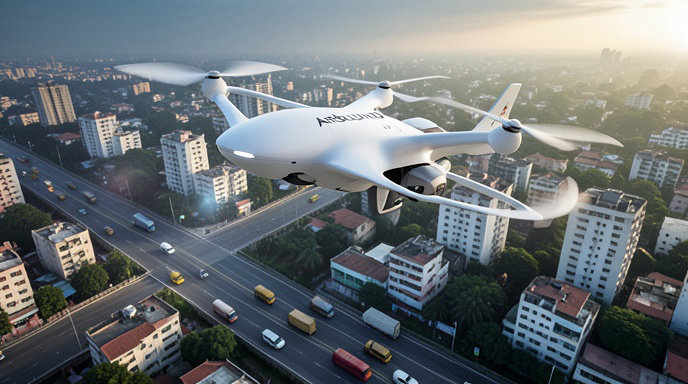
The core of Airbound's pitch is its proprietary drone technology, which borrows more from rocketry than traditional aviation. The company's flagship platform, known as the TRT (Tilt-Rotor Tail-sitter) drone, is engineered for extreme efficiency.
Weighing just a few kilograms itself, the airframe is built from lightweight carbon fiber composites and designed to be ultra-aerodynamic. Unlike common quadcopter delivery drones that are energy-intensive and limited in range, Airbound's blended-wing, tail-sitter design takes off vertically like a helicopter and then tilts to fly horizontally like a plane. This allows for highly efficient forward flight.
Key specs highlighted by the company include the ability to carry a payload of up to 4-5 kilograms over distances exceeding 50-100 kilometers on a single charge, while keeping manufacturing and operational costs radically low. The focus on low weight and high aerodynamic efficiency is what enables the low-cost economics the company is promising.
What the Funding Will Unlock
With the new $37 million in the bank, Airbound is shifting into a scale-up phase. The company plans to use the capital across three key areas.
First, manufacturing. Airbound will expand its production capacity in India to build hundreds of its TRT drones, moving toward an assembly-line model designed to keep unit costs down.
Second, commercial expansion. The startup is set to launch and expand paid pilot programs with e-commerce, logistics, and healthcare partners. These pilots will test the system for high-frequency, daily deliveries between fulfillment centers and delivery hubs.
Third, regulatory and infrastructure groundwork. Scaling drone delivery in India requires close work with the Directorate General of Civil Aviation (DGCA) and the development of automated ground stations for takeoff, landing, and charging. The funding will accelerate this operational infrastructure.
The Road Ahead for Aerial Logistics
Airbound's raise comes at a pivotal moment for drone delivery in India, where the government has been pushing supportive policies like the Drone Shakti and Production-Linked Incentive schemes to foster domestic manufacturing.
If Airbound can deliver on its promise of truly low-cost, long-range delivery, it could unlock a new logistics layer for a country where quick commerce is booming but ground infrastructure remains strained. Success in India would also provide a powerful, cost-effective blueprint for similar emerging markets globally.
The challenge, however, is immense. The company must still prove its economics at scale, navigate complex airspace regulations, and ensure reliability and safety for thousands of daily flights. With $37 million and heavyweight backers now behind it, Airbound has the resources to try.

Get All The Latest Updates Delivered Straight To Your Inbox For Free!