
Pacific Fusion Breaks Ground on Self-Powered Fusion Demo in New Mexico in Race for Commercial Power
TL;DR
- Pacific Fusion has broken ground on a new demonstration facility in Albuquerque, New Mexico, designed to prove its pulsed magnetic fusion system can generate more energy than it consumes.
- The company's approach uses affordable, high-current electrical pulses to compress fuel, aiming to achieve facility-level net gain — a critical milestone known as Q>1 that has eluded commercial fusion efforts for decades.
- If successful, the demo could validate a faster, cheaper path to commercial fusion power and position Pacific Fusion at the forefront of the race to deliver clean, limitless energy to the grid in the 2030s.
A Desert Bet on the Future of Energy
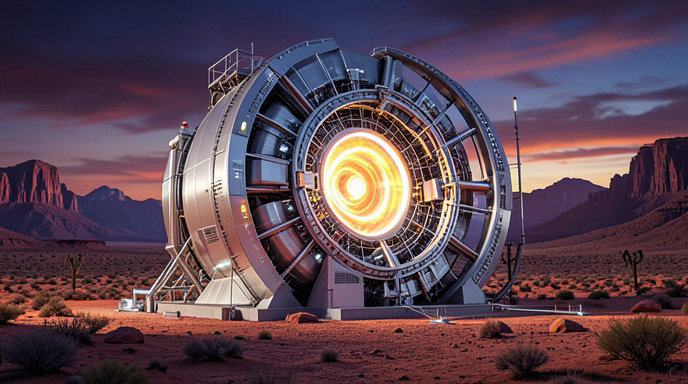
In the high desert outside Albuquerque, New Mexico, construction has begun on what Pacific Fusion hopes will be the machine that finally makes fusion power make sense. The Alameda, California-based startup, which emerged from stealth in 2024 with over $900 million in funding, has officially broken ground on its first full-scale demonstration facility — a building-sized pulsed power system designed to do something no commercial fusion company has yet achieved: power itself.
The facility, located near Sandia National Laboratories, is not intended to be a commercial power plant. Instead, it is a physics and engineering proving ground. Its sole mission is to demonstrate net facility gain — producing more energy from fusion reactions than the entire facility draws from the grid to run the shot. For an industry that has promised clean, nearly limitless energy for more than 70 years, that milestone is the line between science experiment and viable power source.
Why New Mexico
Pacific Fusion's choice of Albuquerque is deliberate. The company’s technology traces its lineage directly to Sandia’s Z Machine, the world’s most powerful pulsed-power facility, which has been firing massive electrical pulses to create fusion conditions for decades. By building next door, Pacific Fusion gains access to a deep talent pool of pulsed-power physicists and engineers, specialized supply chains, and decades of institutional knowledge.
The new site will house the company’s demonstration system, a modular, repetitive pulsed-power driver that is expected to be orders of magnitude more efficient and far cheaper to build than traditional approaches. While the company has not disclosed the exact footprint, the facility is expected to come online for first integrated tests in 2027, with full demonstration shots to follow shortly after.
How Pacific Fusion's Technology Actually Works
Unlike the tokamaks and stellarators pursued by companies like Commonwealth Fusion Systems and Type One Energy, which use powerful magnetic fields to hold superheated plasma steady for seconds at a time, or laser-based systems like those at the National Ignition Facility (NIF) and Focused Energy, Pacific Fusion is pursuing pulsed magnetic fusion.
The concept is elegantly brutal. The system stores a massive amount of electrical energy and then releases it in a single, 100-nanosecond pulse of roughly 60 million amps. That pulse travels down concentric aluminum liners — affordable, replaceable cylinders that act as the first wall. The immense magnetic pressure generated by the current crushes a cylinder of deuterium-tritium fuel inside, heating and compressing it to over 100 million degrees Celsius until fusion occurs.
The key innovation, according to the company’s founders — a team that includes former Sandia and Lawrence Livermore National Laboratory leaders — is efficiency and cost. Traditional pulsed-power machines are single-shot, laboratory-scale behemoths. Pacific Fusion claims its architecture is highly modular, uses solid-state switching, and can fire rapidly and repeatedly at a fraction of the cost per shot. The aluminum liners, which vaporize with each pulse, are designed to be cheap enough to be replaced like a cartridge, making rapid iteration and eventually, commercial operation economically feasible.
Why "Powering Itself" Is The Milestone That Matters
To the public, fusion breakthroughs are often framed as "ignition" or "net gain," but those terms hide important nuances. In December 2022, NIF famously achieved scientific breakeven, where the fusion energy out exceeded the laser energy delivered to the target. However, the lasers themselves required hundreds of times more energy from the wall plug than they delivered.
Pacific Fusion is targeting a much harder and more commercially relevant metric: net facility gain, or Q_total greater than 1. That means the fusion energy produced must exceed all the energy the facility consumes to charge, fire, cool, and operate — the true wall-plug breakeven.
Achieving this would prove two things at once. First, that the underlying physics works at a gain high enough to be useful. Second, that the engineering — the efficiency of energy storage, delivery, and conversion — is efficient enough to be the foundation of a power plant. Without both, fusion remains a net energy sink, no matter how impressive the reaction inside.
A Crowded Race Gets More Intense
Pacific Fusion’s groundbreaking comes as the private fusion race accelerates dramatically. Commonwealth Fusion Systems is building its SPARC tokamak in Massachusetts, Helion Energy is constructing its Polaris device in Washington, and TAE Technologies continues to pursue its field-reversed configuration. Billions in private capital and new federal support through the Department of Energy’s Milestone-Based Fusion Development Program have pushed the field from academic labs toward construction sites.
What sets Pacific Fusion apart is its claim of affordability and speed. While a tokamak power plant is projected to cost billions, the company has argued its pulsed approach could lead to a 100-megawatt commercial plant for a fraction of that cost, with a development timeline measured in years, not decades. Investors including General Catalyst, Breakthrough Energy Ventures, and Lowercarbon Capital are betting that this leaner approach can leapfrog more mature but more complex designs.
What Comes Next for Clean Energy
If the New Mexico demonstration succeeds, the implications extend far beyond one company. A validated, net-gain pulsed system would provide the first credible blueprint for a fusion power plant that could actually sell electricity. Pacific Fusion’s roadmap calls for a subsequent commercial prototype capable of putting net electricity on the grid in the early 2030s.
Failure, or even partial success, would still provide invaluable data for the entire field on the scaling laws of pulsed magnetic fusion. But success would fundamentally change the energy conversation. Fusion offers carbon-free, always-on power without long-lived radioactive waste or meltdown risk, using fuel derived from seawater and lithium. A self-powered demonstration would move it from a perpetual 20-years-away promise to an engineering problem with a known solution.
For now, all eyes in the fusion world are on the New Mexico desert. Concrete is being poured, capacitors are being installed, and the countdown to a shot that has to power itself has begun.

Get All The Latest Updates Delivered Straight To Your Inbox For Free!