
Waymo Scales Fast With 49 Percent Texas Fleet Surge
TL;DR
- Waymo grew its active Texas fleet by 49 percent in the past month, with most growth concentrated in Austin as it scales up fully driverless ride-hailing.
- New data points to emerging hotspots beyond downtown Austin, including South Congress, East Austin, the airport corridor, and early staging activity around Houston and Dallas.
- The surge intensifies pressure on Tesla, Zoox and Uber partners, while pushing Texas regulators and city officials to confront safety, jobs, and infrastructure questions.
Austin Is Now Waymo's Biggest Bet Outside California and Arizona
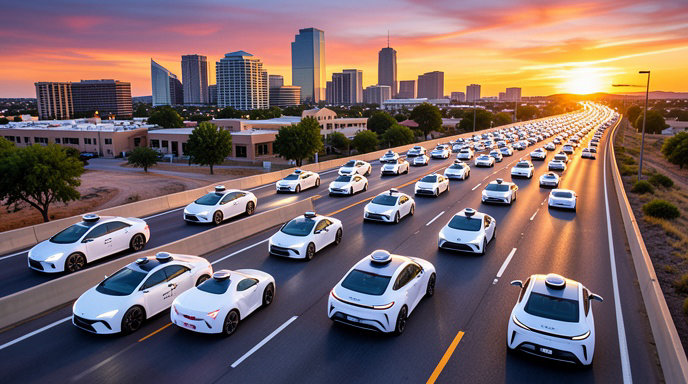
Waymo has shifted into aggressive scale-up mode in Texas. Over the past month, the company's active fleet in the state jumped 49 percent, marking one of its fastest regional expansions to date and a clear signal that Texas is now central to its national robotaxi strategy.
The growth follows months of steady buildup in Austin, where Waymo launched fully autonomous commercial rides in partnership with Uber earlier this year. What started as a limited downtown service area with a couple hundred Jaguar I-Pace and Zeekr vehicles has rapidly evolved into a sprawling, high-density operation running day and night.
Fleet tracking data shows Austin now hosts well over 700 active Waymo vehicles, up from under 500 just weeks ago. That puts Texas on par with Los Angeles and Phoenix as one of Waymo's three largest markets by vehicle count, an extraordinary climb for a city that only opened to the public in March.
Where The Growth Is Concentrated
The latest fleet data makes one thing clear: central Austin remains ground zero. The highest vehicle density continues to cluster around Downtown, the University of Texas campus, South Congress, Zilker, and East Austin — areas with heavy ride-hail demand, dense nightlife, and strong Uber integration.
But the map is changing fast. The fastest growth in trips and vehicle positioning is now happening along three corridors:
First, the airport corridor stretching from East Austin to Austin-Bergstrom International Airport has seen a sharp spike in driverless activity, suggesting Waymo is prioritizing lucrative airport runs.
Second, North Austin around The Domain, Apple’s campus, and the tech corridor is emerging as a second major hub, with increased early-morning and commute-hour deployments.
Third, West Austin and the South Lamar area are showing new late-night clustering, a sign Waymo is extending hours and pushing into more residential pickup zones.
New Hotspots Emerging Across Texas
Perhaps the most intriguing shift is outside Austin. While Austin accounts for nearly all of the current Texas rides, fleet logistics data and vehicle sightings point to early staging in Houston and the Dallas-Fort Worth metro.
In Houston, Waymo vehicles have been spotted conducting mapping and supervised testing in the Energy Corridor, Galleria, and downtown areas, echoing the playbook Waymo used before launching in Austin and Atlanta. In Dallas, activity around Legacy West, Uptown, and DFW Airport suggests validation testing is accelerating.
Waymo has not yet announced commercial launch dates for either city, but the pattern is familiar: map, test with safety drivers, go driverless, then flip the switch with Uber. If history holds, Houston could be next in line for late 2026 or early 2027.
Why Texas, And Why Now
Texas offers Waymo a near-perfect combination for scaling: friendly statewide autonomous vehicle regulation, sprawling car-dependent metros, year-round good weather, and a massive ride-hail market without the need for city-by-city permits required in California.
The partnership with Uber has also been a force multiplier. By plugging directly into Uber’s demand network in Austin, Waymo has been able to fill seats without building its own rider base from scratch. That has allowed it to add vehicles aggressively while maintaining high utilization — the key metric for making robotaxis economically viable.
At the same time, Waymo is racing to deploy its next-generation Zeekr RT vans and updated I-Paces before costs rise and competition tightens. Adding nearly 50 percent more capacity in a single month suggests its depots, charging infrastructure, and remote assistance operations in Austin are finally ready for true scale.
What This Means For Competition
The Texas surge puts direct pressure on Tesla, which launched its own limited Robotaxi pilot in Austin in June. While Tesla is betting on a vision-only, owner-supplied fleet model, Waymo is already operating at hundreds of vehicles with paying Uber customers and a proven safety record.
It also complicates the position of Zoox, Cruise’s successor efforts, and Hyundai-backed Motional, all eyeing Texas as a launchpad. Uber, notably, is playing both sides — partnering with Waymo in Austin and Atlanta while also working with other AV developers — but Waymo’s rapid fleet build gives it leverage as the preferred supplier.
For traditional ride-hail drivers and fleet operators, the message is stark: driverless supply is no longer a pilot project. In core Austin nightlife and downtown zones, Waymo vehicles are now a common sight, available at Uber prices.
Regulation And The Road Ahead
Texas law remains among the most permissive for autonomous vehicles in the U.S., with statewide preemption preventing cities from banning driverless cars. That has enabled Waymo’s speed, but it is also drawing scrutiny.
Austin city council members and safety advocates have called for more incident data transparency, curb management for robotaxi pickup zones, and clarity on how Waymo vehicles interact with emergency responders. State lawmakers, meanwhile, are watching insurance liability and job impacts as fleets scale from hundreds to thousands.
Nationally, Waymo now operates more than 2,500 vehicles across its U.S. markets and provides over a million paid rides per month. If Texas growth continues at this pace, analysts expect Austin alone could surpass 1,000 active vehicles by year-end, with Houston following close behind.
The bottom line is that Waymo’s 49 percent Texas jump is not a one-off fleet reshuffle. It is a deliberate, infrastructure-backed scale-up — and a preview of how fast autonomous mobility could reshape major Sun Belt cities in the next 18 months.

Get All The Latest Updates Delivered Straight To Your Inbox For Free!