
Colossal Biosciences Launches AI Platform to Supercharge De-Extinction Efforts
TL;DR
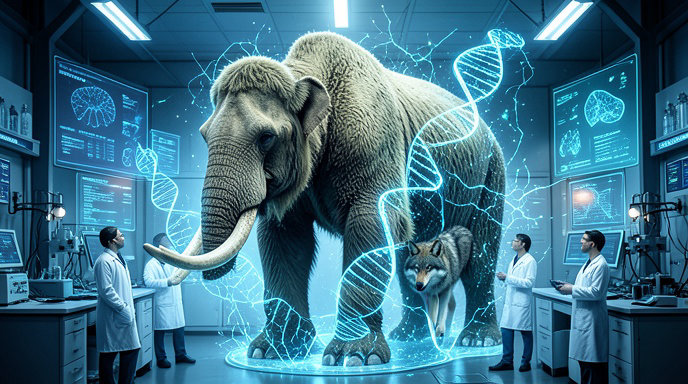
- Colossal Biosciences has unveiled a new AI-powered computational biology platform designed to dramatically speed up genome engineering for de-extinction projects including the woolly mammoth, dire wolf, and dodo.
- The platform automates ancient DNA reconstruction, gene-edit targeting, and embryo viability prediction, cutting what took months of lab work down to days.
- Futurist Peter Diamandis has launched a new venture fund to back startups building on top of Colossal's AI stack, betting de-extinction tech will power longevity, conservation, and biotech breakthroughs.
A Mammoth Task, Now Powered by AI
Colossal Biosciences, the Dallas-based de-extinction startup valued at more than $10 billion, is betting that artificial intelligence is the missing key to bringing back lost species.
This week the company pulled back the curtain on its new AI platform for computational de-extinction, a full-stack system built to solve one of the hardest problems in synthetic biology: how to reliably reconstruct, edit, and test ancient genomes at scale.
Until now, Colossal's work on the woolly mammoth, thylacine, dodo, and dire wolf has relied on painstaking manual genomics. Scientists had to piece together fragmented ancient DNA, compare it to living relatives like Asian elephants and gray wolves, decide which gene edits would recreate cold tolerance, tusk growth, or pack behavior, and then test those edits cell by cell. Company executives say AI changes that timeline entirely.
What The New Platform Actually Does
According to Colossal, the platform combines three core engines.
The first is ancient genome assembly. Trained on more than 200 extinct and extant genomes, the model fills gaps in degraded DNA from fossils and museum specimens, predicting missing sequences with far higher accuracy than traditional alignment tools.
The second is multiplex edit design. Leveraging CRISPR advances developed in Colossal's labs, the AI recommends the minimal set of gene edits needed to confer mammoth-like traits such as long hair, fat metabolism, and cold-adapted hemoglobin, or dire wolf traits like larger body size and distinctive white coat. It also predicts off-target effects before any lab work begins.
The third is developmental modeling. Using single-cell data from engineered elephant and wolf cell lines, as well as Colossal's famous woolly mouse model, the system forecasts which edited embryos are most likely to develop successfully, reducing failed pregnancies in surrogates.
Colossal says early internal benchmarks show a 10x speedup in target identification and a major drop in failed cell lines. The company plans to open limited API access to academic partners and conservation groups in early 2027.
From Dire Wolves to Woolly Mammoths: Where Projects Stand
The announcement lands just months after Colossal made global headlines for producing three engineered dire wolf pups - Romulus, Remus, and Khaleesi - using 20 targeted edits to gray wolf DNA.
The company says the AI platform was partially used in that project but is now fully operational for its next milestones: woolly mammoth calves engineered from Asian elephant cells targeted for 2028, thylacine joeys, and gene-edited dodo precursors.
CEO Ben Lamm has framed the AI as Colossal's AWS moment, comparing the de-extinction toolkit to cloud computing. Just as Amazon turned its internal infrastructure into a platform others could build on, Colossal wants other biotech startups to build longevity therapies, disease-resistant livestock, and coral restoration tools on its genome-engineering stack.
Why Peter Diamandis Is Going All In
That platform vision is exactly why XPRIZE founder and futurist Peter Diamandis has launched a new fund to back startups building on the breakthrough technology.
Diamandis, best known for the Ansari XPRIZE and Singularity University, confirmed this week he is co-leading a new longevity and exponential biotech fund that will prioritize companies using Colossal's AI models and gene-editing libraries.
In interviews, Diamandis argued de-extinction is not just about nostalgia. The same AI that figures out how mammoths survived the Ice Age could help engineer human cells to resist aging, improve endangered species fertility, and create climate-resilient agriculture. He called Colossal's platform a foundational layer for the bio-economy, similar to what large language models were for software.
The fund is expected to start with investments in the $500,000 to $5 million range, targeting spinouts focused on reproductive technology, artificial wombs, avian genome engineering, and AI-driven protein design.
What It Means For Biotech And Conservation
For the broader tech world, Colossal's move signals a convergence of AI and biology that has been building for years.
Investors who once saw de-extinction as science fiction now view it as applied AI infrastructure. Colossal has now raised over $600 million from investors including US Innovative Technology, Fidelity, and In-Q-Tel, and its spinouts like Breaking, focused on plastic degradation, and Avadra, focused on bird conservation, already hint at commercial applications beyond mammoths.
Conservationists remain split. Critics argue resources should focus on saving living elephants and wolves rather than engineered proxies. Supporters, including several Indigenous groups partnered with Colossal on rewilding in the Arctic and Tasmania, say AI-accelerated tools could rescue genetic diversity that would otherwise be lost forever.
What Comes Next
Colossal says the next 12 months will be critical. The company plans to publish peer-reviewed validation of its AI genome assembly, expand its foundry lab in Dallas, and announce the first three external startups built on its platform at an upcoming showcase.
If the AI delivers on its promise, the timeline from DNA to living animal could shrink from years to months. And with Diamandis now actively funding an ecosystem around it, de-extinction may be moving from a single company's moonshot to an entire industry.
For now, the mammoth is still the mascot. But the real product, Colossal insists, is intelligence - artificial intelligence that can read extinct code and rewrite the future of life.

Get All The Latest Updates Delivered Straight To Your Inbox For Free!