
Waymo Heads to Munich: How Germany Became Europe's Robotaxi Hotspot
TL;DR
- Waymo is bringing its autonomous vehicles to Munich for its first major European testing program, starting with manual mapping and supervised autonomous driving in the city center and surrounding areas.
- Germany's 2021 Autonomous Driving Act, which was the first law in the world to allow Level 4 driverless vehicles on public roads without a human safety driver, has made the country the continent's most attractive testing ground for robotaxis.
- The Munich expansion puts Waymo in direct competition with European players like Volkswagen's MOIA, Mobileye, and Lyft-backed ventures as the race to launch a commercial, fully driverless ride-hailing service in Europe accelerates.
Why Munich, Why Now?
Waymo has spent more than a decade perfecting its robotaxi service in the United States, with fully driverless commercial operations now running in San Francisco, Los Angeles, Phoenix, and Austin. Its next frontier is Europe, and Munich is the starting line.
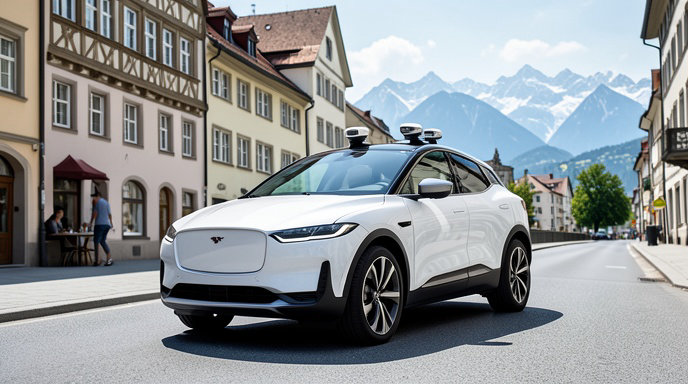
The company has confirmed it will begin driving in Munich with its all-electric Jaguar I-PACE fleet, initially with human safety drivers behind the wheel for mapping and system validation. The vehicles will collect detailed data on the city's complex road layouts, traffic patterns, signage, and seasonal weather conditions. This mapping phase is a critical prerequisite before any supervised autonomous testing begins, and well before any driverless commercial service could be considered.
Munich was not chosen by accident. As the home of BMW and a dense ecosystem of automotive suppliers, engineering talent, and research institutions like the Technical University of Munich, the city offers both technical infrastructure and a deep talent pool. It is also one of Germany's most congested and mobility-forward cities, with a public that is already familiar with car-sharing, ride-hailing, and advanced driver-assistance systems. For Waymo, it is the ideal real-world laboratory to prove its Waymo Driver can handle European driving culture, from dense Altstadt streets and tram interactions to high-speed Autobahn-adjacent roads.
Germany's Regulatory Fast Lane
The single biggest reason Waymo and its rivals are looking to Germany is regulation. In 2021, Germany passed the Autonomous Driving Act, making it the first country in the world to create a legal framework that allows Level 4 autonomous vehicles to operate on public roads in defined operational domains without a human driver present.
Unlike the patchwork of state-by-state rules in the United States, the German law provides a clear, federal path to approval. Companies can apply to the Federal Motor Transport Authority to operate driverless vehicles in a specific area, provided they have technical approval from agencies like TÜV SÜD and oversight from a technical supervisor. An update to the law has further streamlined the approval process for commercial operations.
This progressive stance has transformed Germany into Europe's de facto AV proving ground. Cities like Hamburg, Berlin, and Munich have already hosted pilot projects from Volkswagen, Mobileye, and other developers. The government has actively encouraged testing corridors and digital infrastructure, including high-definition mapping and vehicle-to-infrastructure communication, to support autonomous operations. For a company like Waymo that is ready to move beyond testing and toward commercialization, that regulatory clarity is invaluable.
What Waymo Will Actually Do on Munich's Streets
Waymo's European debut will be deliberately methodical, mirroring its playbook in the U.S. The rollout will happen in distinct phases.
First comes manual driving. For several months, the Jaguar I-PACEs will be driven manually to build a highly detailed map of Munich, including lane geometry, traffic light locations, speed limits, and curb details. At the same time, the vehicles will gather data on how local drivers, cyclists, and pedestrians behave.
Next is supervised autonomous testing. Once the mapping is complete, Waymo will begin testing its autonomous system with a trained safety driver in the driver's seat. This allows engineers to validate the system's performance in European conditions, including navigating narrow cobblestone streets, complex roundabouts, priority-to-the-right intersections, and sharing the road with trams and a high volume of bicycles.
Only after extensive validation and regulatory approval would Waymo consider fully driverless testing without anyone in the driver's seat, which is the final step before a commercial robotaxi service. The company has not announced a timeline for a public ride-hailing launch in Munich, emphasizing that safety and regulatory compliance will dictate the pace.
The Race for Europe's Robotaxi Crown
Waymo's arrival in Munich signals that the competition for Europe's first large-scale commercial robotaxi network is heating up. While Waymo is the clear leader in the U.S. market, Europe presents a different competitive landscape.
Intel's Mobileye has been testing in Germany for years and has partnered with Volkswagen to develop autonomous shuttles. Volkswagen's own MOIA division is preparing to launch its ID. Buzz AD autonomous ride-pooling service in Hamburg in 2026. Other players, including Toyota-backed Pony.ai, French startup EasyMile, and Uber-affiliated operators, are all vying for a foothold.
For Waymo, success in Munich could provide a blueprint for expansion to other European capitals. The challenges are significant — different national regulations, diverse driving cultures, and dense historic city centers that are far more complex than the wide, grid-like streets of Phoenix. But the prize is also enormous: a European ride-hailing market worth billions and a chance to set the global standard for autonomous mobility.
If Waymo can prove its technology works safely and reliably on Munich's streets, it will not just be a milestone for the company. It will be a clear sign that Germany's bet on becoming the world's most AV-friendly nation is paying off, and that the era of the European robotaxi is finally moving from test track to city street.

Get All The Latest Updates Delivered Straight To Your Inbox For Free!